
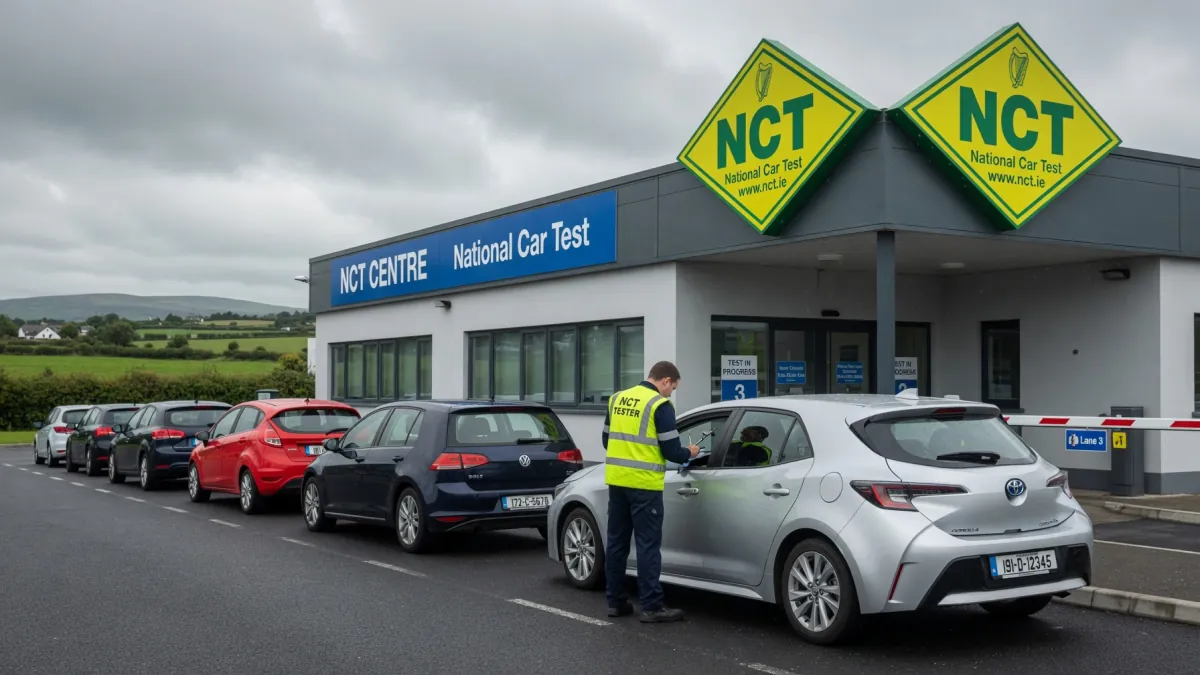
The NCT is mandatory for all cars 4+ years old, then every 2 years until 10 years, then annually. It costs €60 (online booking). Book at ncts.ie. You need a valid NCT to renew your motor tax. The test takes about 40 minutes and covers brakes, lights, emissions, suspension, tyres and bodywork. A free re-test within 30 days covers only the failed items.
What is the NCT?
The National Car Test (NCT) is Ireland's compulsory roadworthiness inspection for passenger vehicles. Introduced in January 2000, it is overseen by the Road Safety Authority (RSA) and operated by the National Car Testing Service (NCTS), which is run by Applus+ under contract.
The NCT exists to ensure that vehicles on Irish roads meet minimum safety and environmental standards. It is a legal requirement under the Road Traffic Act 2004 and implements EU Directive 2014/45/EU on periodic roadworthiness testing.
Ireland was one of the last EU countries to introduce compulsory vehicle testing. Since 2000, the NCT has tested over 20 million vehicles across the country.
Who needs an NCT?
Every passenger car (category M1) registered in Ireland that is 4 or more years old must hold a valid NCT certificate. The testing schedule depends on the vehicle's age:
First test is due on the 4th anniversary of registration. Then every 2 years after that.
Once your car reaches 10 years from first registration, annual testing is required.
Unlike the UK MOT (which exempts pre-1977 vehicles), Ireland has no age-based exemption. All cars 4+ years old need an NCT, regardless of classic or vintage status.
What about other vehicles?
- Commercial vehicles (vans, trucks, buses) are tested under the separate CVRT (Commercial Vehicle Roadworthiness Test).
- Electric and hybrid cars must be tested like any other car — the emissions portion is skipped, but all other checks apply.
- Motorcycles are not currently subject to mandatory roadworthiness testing in Ireland.
- Agricultural vehicles, military vehicles and certain special-purpose vehicles are outside the NCT scope.
NCT fees in 2026
| Fee type | Cost | Notes |
|---|---|---|
| Full NCT | €60 | Standard test fee, payable when booking |
| Re-test (within 21 days, minor items) | Free | Visual/minor items only, same centre |
| Re-test (full or outside 21 days) | €40 | Full mechanical re-test or late re-test |
You can pay by card online when booking, or by card or cash at the test centre on the day. Keep your receipt — you may need it if you are querying a result.
How to book your NCT
There are two ways to book:
Online (recommended)
- Go to ncts.ie
- Enter your vehicle registration number
- Select a test centre and available date/time
- Confirm and pay by card
- Receive your confirmation by email
By phone
Call the NCTS booking line:
or +353 1 413 5992
Lines are open Monday–Saturday. Have your registration number ready.
You can book up to 90 days before your due date without losing validity — the new cert runs from your original due date, not the test date. This is the single best tip for avoiding stress.
Where are the test centres?
There are 47 NCTS test centres across all 26 counties. Every county has at least one centre, and larger cities (Dublin, Cork, Galway, Limerick) have multiple centres.
Find your nearest NCT centre on our interactive mapWhat to bring on the day
The card-format logbook issued by Revenue. This is mandatory — you will be turned away without it.
A driving licence or passport. Not strictly required, but recommended.
Card or cash. If you paid online when booking, no further payment is needed.
See the preparation checklist below.
Car preparation checklist
What happens on the day
The test takes approximately 30–40 minutes. Budget about an hour in total, including check-in and waiting for results. Here's the step-by-step process:
Present your VRC at reception, confirm your details and hand over your keys.
The tester walks around your vehicle checking lights, bodywork, tyres, mirrors, windscreen and registration plates.
Visual check of fluid levels, battery security, brake fluid reservoir and engine bay condition.
Seatbelts in every seat, dashboard warning lights (especially airbag and ABS), horn, wipers, washers, mirrors and seat security.
Your car is driven onto a rolling road that measures braking force and left-to-right balance for both the service brake and handbrake.
An automated plate tester shakes each wheel to measure shock absorber performance.
Exhaust gas analysis — CO and HC for petrol engines, smoke opacity for diesels. Skipped for electric vehicles.
A beam tester checks dipped and main beam alignment and pattern.
The car is raised on a lift for a thorough look at the chassis, exhaust, steering, suspension components and brake lines.
You receive your result report within minutes. If you pass, your NCT disc is issued on the spot.
Most centres have a viewing gallery. You can observe the entire test through a window, but you are not permitted on the test lane.
What gets tested
The NCT covers approximately 60 individual test items grouped into these categories:
Pads, discs, drums, lines, hoses, ABS, handbrake, brake fluid
All bulbs, headlight alignment, indicators, brake lights, fog lights, plate lights, dashboard warnings
Rack, power steering, ball joints, track rod ends, shock absorbers, springs, bushes, wheel bearings
Tread depth (min 1.6 mm), damage, mismatched types, wheel condition, wheel nuts
Structural integrity, corrosion, doors, boot/bonnet latches, bumpers, sharp edges
Windscreen chips/cracks, wipers, washers, all mirrors, window tinting
System integrity, mounting, CO/HC (petrol), smoke opacity (diesel), catalytic converter
All seatbelts, seats, head restraints, horn, speedometer, airbag light, VIN plate, reg plates
Understanding your NCT result
There are four possible outcomes. Whatever the result, you get a printed report listing every item checked — for a line-by-line walkthrough of what each code and category means, see our NCT report explained guide.
Pass
Your vehicle meets all standards. You receive your NCT disc on the spot, valid for 1 or 2 years depending on vehicle age.
Pass with advisory
Your car passes and you get the disc, but some items are starting to wear. These are not failures, but should be addressed before your next test.
Fail
One or more items did not meet the standard. You have 21 days to repair and present for re-test. No NCT disc is issued until you pass.
Fail dangerous
Your vehicle has a defect that makes it immediately unsafe to drive. Do not drive it — transport it on a trailer until the defect is fixed.
Re-test rules and time windows
| Scenario | Cost | Time window | Where |
|---|---|---|---|
| Minor / visual items only | Free | Within 21 days | Same centre |
| Full mechanical re-test | €40 | Within 21 days | Same centre |
| Any re-test outside 21 days | €40 | After 21 days | Any centre |
| Re-test at different centre | €40 | Any time | Any centre |
The 21 days are calendar days, not working days. They start from the date of your original test. If day 21 falls on a Sunday or bank holiday, you must present before that date, not after.
Most common NCT failures
Based on published NCTS statistics, these are the items that catch drivers out most often:
Blown bulbs, misaligned headlights, cracked lenses. The single most common reason for failure — and the easiest to prevent.
Worn pads or discs, poor balance between left and right, handbrake not holding. Have a garage check brakes before the test.
Worn shock absorbers, broken springs, perished bushes. Bounce-test each corner — it should settle in 1–2 bounces.
Tread below the 1.6 mm legal minimum, sidewall damage, mismatched types on the same axle.
Particularly older diesels. A long motorway run before the test helps clear the exhaust and can make the difference.
Chips or cracks in the driver's swept area. Most insurers will repair small chips for free.
Worn track rod ends, ball joints or power steering leaks. Listen for clunking sounds over bumps.
Rust on sills, wheel arches or subframe mounts. Common on 10+ year old cars, especially in coastal areas.
Penalties for driving without a valid NCT
Rises to €90 if not paid within 28 days.
5 points if the case goes to court conviction.
Your insurer may refuse or reduce a claim if your NCT is expired.
The fine is only €60, but the insurance risk is where the real damage lies. If you are involved in an accident without a valid NCT, your insurer can void your policy — leaving you personally liable for all costs. A €60 test fee is cheap insurance against that scenario. See our car insurance in Ireland guide for how an expired NCT affects your premium and claim history.
Tips to pass your NCT first time
Get a pre-NCT check
Most garages offer a pre-NCT inspection for €30–50. They will flag anything that would fail and give you time to fix it. Much cheaper than a re-test.
Check every bulb
The night before, have someone walk around the car while you test every light — headlights (dipped and main beam), indicators, brake lights, reverse, fog, number plate lights.
Warm up the engine
Drive for at least 20 minutes before the test, ideally at motorway speed. This brings the catalytic converter to operating temperature and clears exhaust deposits.
Check your tyres
Use a tread depth gauge — the legal minimum is 1.6 mm but anything under 2 mm should be replaced. Check for sidewall damage and ensure the same type is fitted on each axle.
Test all seatbelts
Pull each belt out fully and let it retract. Check the buckle clicks and releases cleanly. Don't forget rear seats — they all get tested.
Clear dashboard warnings
An illuminated airbag, ABS or engine management light is an automatic fail. If a light is on, get it diagnosed and resolved before the test.
Clean the car
A clean car isn't just courtesy — it lets the tester see lights, plates and bodywork clearly, and shows you take care of the vehicle.
Book 90 days early
Booking early gives you time to fix any issues if you do fail, without the pressure of driving on an expired cert.
Never miss your NCT again
odo.ie tracks your NCT due date and sends you email reminders at 30, 14, 7 and 1 day before it expires — completely free. You can also subscribe to a calendar feed so your NCT, motor tax and insurance dates appear in Google Calendar, Apple Calendar or Outlook.