Almost half of cars fail the NCT — but most failures are cheap, easy fixes you can check at home. Focus on tyres (1.6mm tread, no damage), lights (all working, correctly aligned), wipers, brakes, and dashboard warning lights (all must be off). Spend 30 minutes on this checklist the day before your test and you will dramatically improve your chances of passing first time.
Why almost half of cars fail the NCT
According to NCTS data, the top reasons for failure are remarkably consistent year after year — and remarkably preventable. The vast majority are items you can check yourself in under an hour:
Blown bulbs, misaligned headlights, cracked lenses.
Tread below 1.6 mm, sidewall damage, mismatched types.
Worn shock absorbers, broken springs, perished bushes.
Worn pads/discs, poor balance, handbrake not holding.
High CO/HC or diesel smoke. Often fixable with a long drive.
Worn track rod ends, ball joints, power steering leaks.
Chips in the driver's line of sight, missing mirrors.
Not retracting, frayed webbing, faulty buckles.
Items 1, 2, 7 and 8 can all be checked and fixed at home for under €20. That alone covers over 55% of all NCT failures.
The 12-point pre-NCT checklist
Work through these 12 checks a week or two before your test. Each item tells you exactly what to look for, what the tester will measure, and how to fix the most common problems.
Tyres
~18% of NCT failures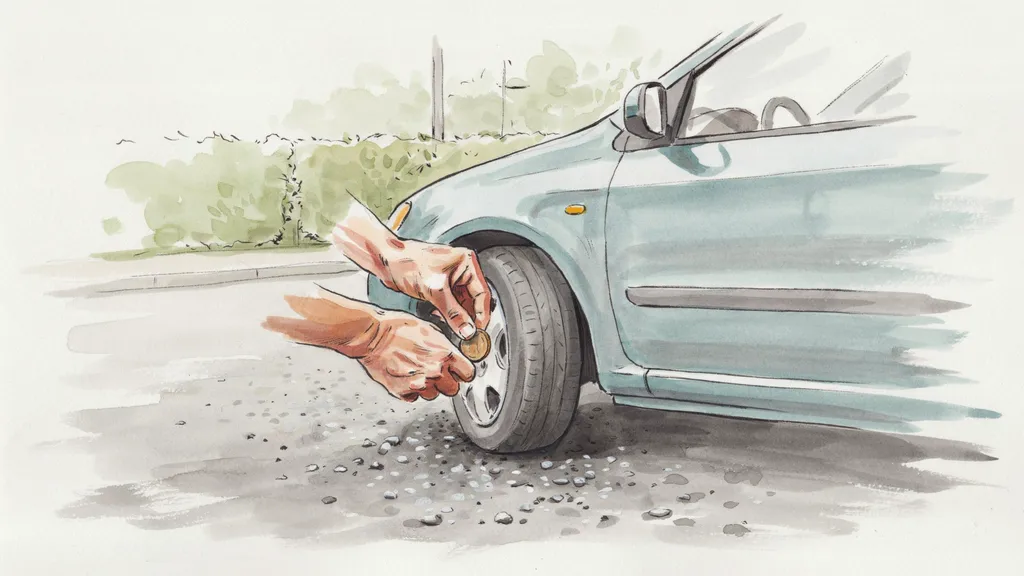
Tyres are the second most common reason for NCT failure. The tester will measure tread depth, check for damage, and verify the correct type is fitted on each axle.
What the NCT checks
- Tread depth — minimum 1.6 mm across the central three-quarters of the tread, around the entire circumference of the tyre.
- Sidewall condition — no bulges, cuts, cracks or exposed cords.
- Matching tyres — same type (radial or cross-ply) on each axle. Ideally same brand and size per axle.
- Correct size — must match the specification for your vehicle.
- Tyre pressure — not directly measured, but obviously flat or over-inflated tyres will be noted.
How to check at home
Insert a 20 cent coin into the tread groove. If you can see the gold outer ring, your tread is below 3 mm and approaching the legal limit. If the entire gold ring is visible, you are likely below 1.6 mm and will fail.
- Check all four tyres and the spare.
- Run your hand over the tread surface — uneven wear often indicates alignment or suspension problems.
- Look at sidewalls for bulges or cracking, especially on older tyres.
The legal limit is 1.6 mm, but grip drops significantly below 3 mm, especially in rain. If you are close, replace now. The cost of two tyres is less than an accident.
Lights
~30% of NCT failures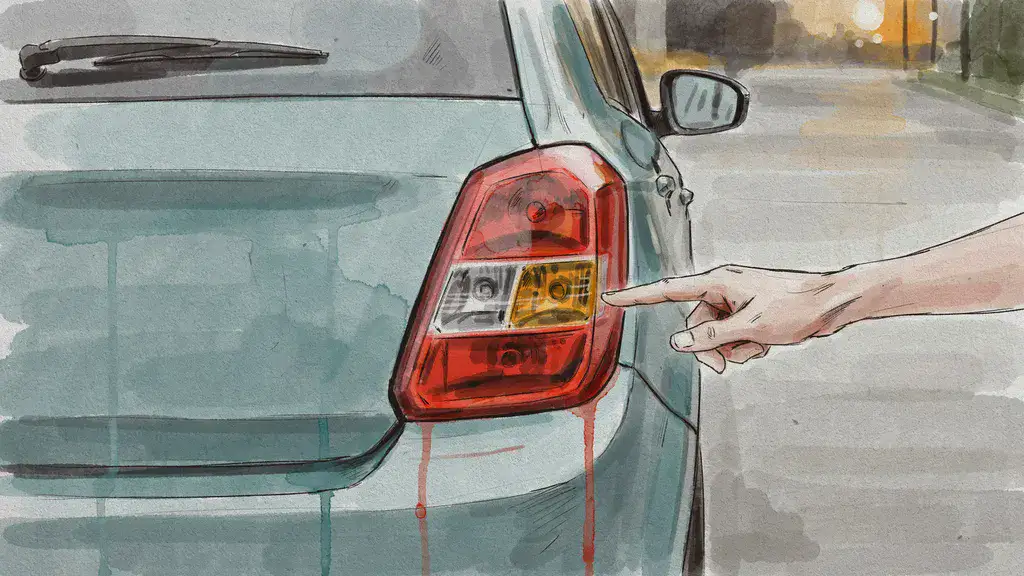
Lighting is the number-one reason for NCT failure in Ireland, every single year. The good news: a replacement bulb costs €3–10, and you can check every light in five minutes.
Every light the NCT checks
Dipped beam, main beam, alignment (both sides)
Front, rear, side repeaters, hazard warning
Both sides + high-level third brake light
Tail lights, fog light(s), reverse light(s)
Must illuminate the rear plate evenly
All warning lights must illuminate on start, then clear
How to check at home
- Park facing a wall at night. Turn on each light in sequence and walk around the car.
- Ask someone to press the brake pedal while you check the rear.
- Headlight alignment — if one beam points noticeably higher or lower than the other, get it adjusted at a garage (typically €20–30).
- Check that lens covers are not cracked, cloudy, or have moisture inside.
This tiny bulb is the single most-overlooked light on the car. It sits above the rear number plate and is easy to miss. Check it.
Wipers & washer fluid
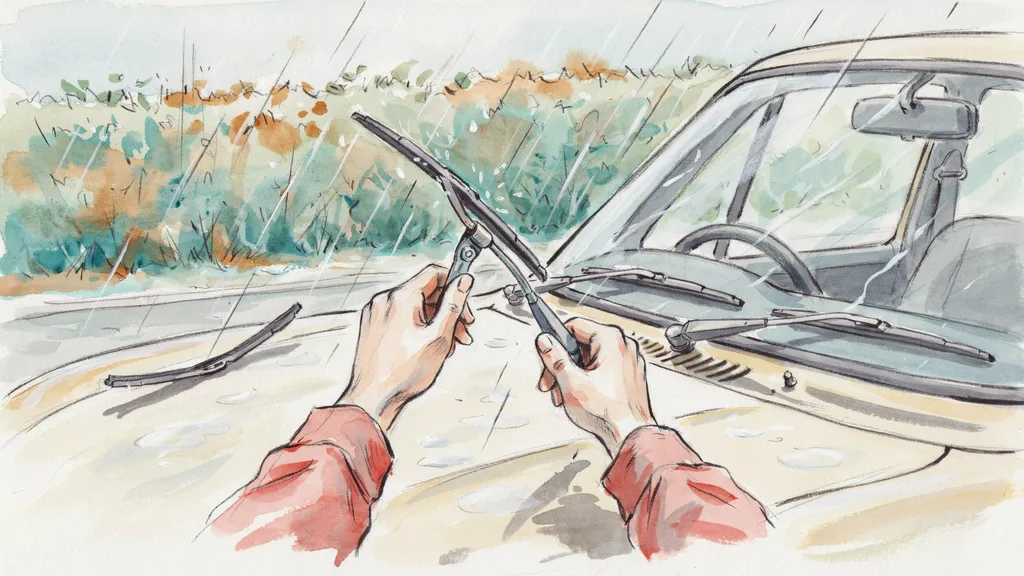
The tester will activate your wipers and washers and check they clear the windscreen effectively. Worn blades leave streaks and can fail.
What to check
- Front wipers — no streaking, juddering, or missed areas. Replace blades if older than 12 months.
- Rear wiper — same criteria. Often forgotten.
- Washer jets — both front jets must spray onto the windscreen. Clear blocked nozzles with a pin.
- Washer fluid level — fill the reservoir. Water is fine, but a screenwash additive prevents freezing and cleans better.
A pair of front wiper blades costs €10–20 and takes 2 minutes to fit. A 5-litre bottle of screenwash is under €5. Total spend: under €25.
Suspension & steering
~15% of NCT failuresSuspension and steering account for around 15% of all NCT failures. The tester uses an automated plate tester and visual inspection.
What the NCT checks
- Shock absorbers — measured on a suspension tester. Must meet minimum damping values.
- Springs — no cracks, breaks, or excessive corrosion.
- Ball joints and bushes — checked for play and wear.
- Track rod ends — a common fail; checked for excessive play.
- Steering rack — play in the steering wheel before the wheels respond.
- Power steering — fluid level, leaks, operation.
The home bounce test
Press down firmly on each corner of the car and release. The car should bounce up and settle within 1–2 bounces. If it keeps bouncing or feels spongy, the shock absorber on that corner is likely worn.
Steering check
With the car stationary and the engine running, turn the steering wheel gently left and right. If there is more than a small amount of free play before the wheels start to turn, a track rod end or steering component is worn.
Drive slowly over speed bumps. Knocking or clunking sounds from the front usually indicate worn anti-roll bar links, drop links, or ball joints. These are common and relatively inexpensive to replace (€40–80 per side at a garage).
Brakes
~12% of NCT failuresThe NCT measures braking force on a rolling road and checks that the left and right sides are balanced. It also tests the handbrake.
What to check
- Brake pedal feel — should be firm, not spongy. If the pedal sinks slowly when held, there may be a leak.
- Brake fluid level — check the reservoir under the bonnet. Top up to the MAX line if low (use DOT 4 unless the cap says otherwise).
- Handbrake — should hold the car on a slope. If the lever pulls up very high (more than ~6 clicks), adjustment is needed.
- Pulling to one side — if the car pulls left or right when braking, one caliper may be sticking or one pad is more worn than the other.
- Noise — grinding or squealing usually means pads are worn to the metal. Replace before the test.
If you have any doubt about your brakes, have them inspected by a garage. Poor brakes can result in a Fail Dangerous classification, meaning the car should not be driven until repaired. If your car is also overdue a service, see how often you should service your car in Ireland — a full service usually catches brake wear before it becomes an NCT failure.
Fluids
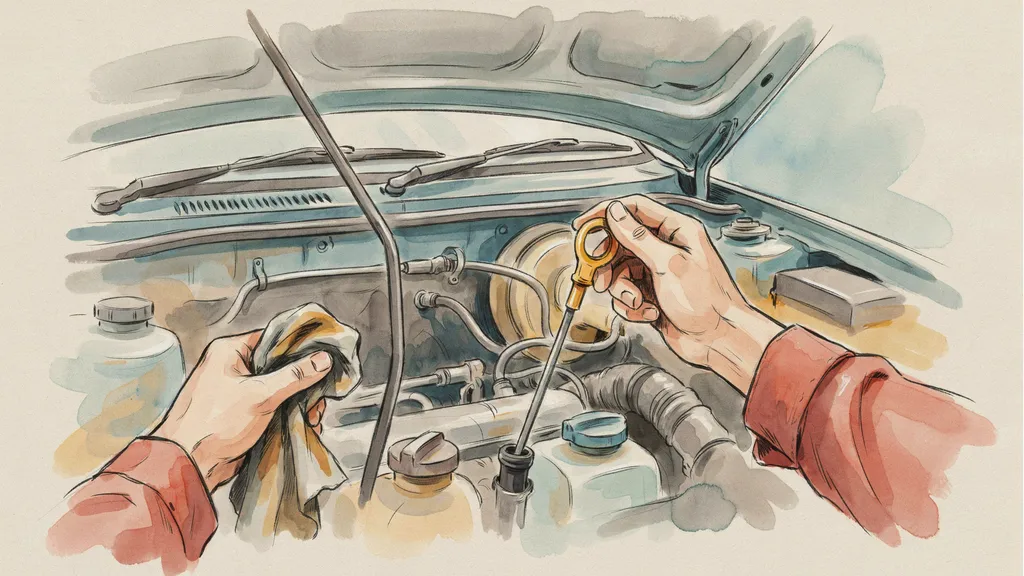
The tester does a visual check of fluid levels and condition. Low or contaminated fluids suggest poor maintenance.
Check these five
Check on the dipstick. Between MIN and MAX, clean and amber-coloured. Top up or change if black and gritty.
Check the expansion tank when cold. Between MIN and MAX. Never open the radiator cap when hot.
Reservoir under the bonnet. Should be between MIN and MAX. If very dark, it may need replacing.
If your car has hydraulic power steering, check the reservoir. Low fluid can cause whining and heavy steering.
Fill the washer reservoir. Test the jets spray correctly onto the windscreen.
Boot & spare wheel access
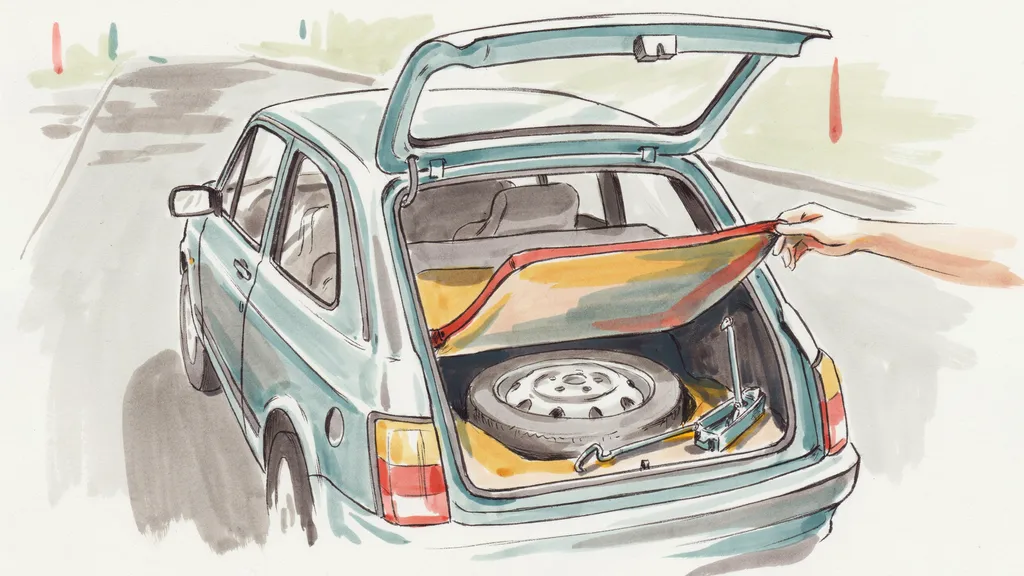
The tester needs access to the boot area to check for structural corrosion underneath and may need to inspect the spare wheel area.
What to do
- Remove everything from the boot — shopping bags, tools, gym bags, child seats stored there.
- Lift the boot floor and make sure the spare wheel (or tyre repair kit) is accessible.
- If you have a jack and wheel brace, leave them in place — they are part of the car's equipment.
- The tester will check the boot latch opens, closes and latches securely from inside and outside.
Heavy items in the boot can affect suspension and brake test results. The car should be at its normal unladen weight during the test.
Dashboard warning lights
When you turn the ignition to the ON position (before starting), all warning lights should illuminate briefly, then clear when the engine starts. Any light that stays on is an automatic fail.
Lights that will fail the NCT
Stays on = fail. Common on older cars after seat sensor or wiring issues.
Stays on = fail. Usually a wheel speed sensor — €50–100 to replace.
Stays on = fail. Get a diagnostic scan (many garages do this for €20–30).
Stays on = fail. Often related to ABS sensor issues.
Some people remove the dashboard warning bulb to hide the light. The tester checks that all warning lights illuminate on start-up. If a required light does not come on at all, that is also a fail.
Number plates
Number plates must comply with Irish regulations on format, font, size and condition. Non-compliant plates are an instant fail.
What the NCT checks
- Legibility — all characters clearly readable from a distance. No fading, peeling or damage.
- Correct format — standard Irish format with the correct font. No stylised, italic or decorative fonts.
- Secure mounting — plates must be firmly fixed, not held on with cable ties or tape.
- Reflective backing — front plate white, rear plate white (not yellow as in the UK).
- Clean — dirt or grime obscuring characters will be flagged.
If your plates are faded or damaged, a replacement set costs around €20–30 from most motor factors. Have them made to the correct legal specification.
Seatbelts
~3% of NCT failuresThe tester checks every seatbelt in the car — not just the front ones. This is a safety-critical item.
What to check
- Pull each belt fully out and let it retract. It should wind back smoothly without sticking.
- Buckle test — click each belt into its buckle. It should lock firmly. Press the release button — it should eject cleanly.
- Webbing condition — look for fraying, cuts or twists in the belt fabric.
- Inertia lock — give the belt a sharp tug. It should lock and prevent further extension. If it doesn't lock, the retractor is faulty.
- All seats — don't forget rear centre and any third-row seats. The tester will check them all.
Mirrors
All required mirrors must be present, securely attached, and provide a clear view.
What to check
- Interior rear-view mirror — present, secure, no cracks or severe delamination.
- Both exterior mirrors — present, secure, glass not cracked. Electric adjustment should work if fitted.
- Mirror glass — no chips, cracks or severe scratches that obstruct the view.
- Mirror housing — should not be loose, broken, or held on with tape.
A replacement mirror glass (just the glass, not the whole unit) typically costs €10–25 and clips into the existing housing. Full mirror replacements are €40–80 depending on the car.
Engine warm-up (test day)
This is the one item you do on the morning of your test, not during your pre-NCT check. It is particularly important for diesel vehicles.
Why it matters
- The catalytic converter needs to reach operating temperature (300°C+) to clean exhaust gases effectively. A cold cat will produce higher emissions readings.
- A diesel particulate filter (DPF) that has been sitting in town traffic can be partially blocked. A motorway run burns off the accumulated soot.
- The engine oil circulates better when warm, reducing internal friction and improving readings.
What to do
- Drive the car for at least 20–30 minutes before your appointment, ideally at motorway speed.
- For diesel vehicles, a 30-minute motorway run is strongly recommended to trigger a DPF regeneration.
- Arrive at the test centre with the engine warm. Do not turn it off and wait in a queue for 30 minutes if you can avoid it.
If your DPF warning light has been appearing, get it resolved before the test. A blocked DPF will fail the emissions test and is expensive to fix if left too long (€300–1,000+).
Quick-reference printable checklist
Print this out or screenshot it. Tick off each item as you go through your pre-NCT check:
| # | Item | What to check | Typical fix cost |
|---|---|---|---|
| 1 | Tyres | Tread ≥1.6 mm, no sidewall damage, matching types | €60–120 per tyre |
| 2 | Lights | Every bulb works, headlights aligned | €3–10 per bulb |
| 3 | Wipers & washers | No streaks, jets spray, fluid full | €10–25 |
| 4 | Suspension | Bounce test, no knocks, no steering play | €40–200 |
| 5 | Brakes | Firm pedal, fluid level, handbrake holds | €80–250 |
| 6 | Fluids | Oil, coolant, brake fluid, screenwash | €5–30 |
| 7 | Boot | Empty, spare accessible, latch works | Free |
| 8 | Dash warnings | All lights clear after start | €20–100 (diagnostic) |
| 9 | Number plates | Legal format, clean, secure | €20–30 |
| 10 | Seatbelts | All retract, buckles work, webbing OK | €30–100 |
| 11 | Mirrors | All present, secure, no cracks | €10–80 |
| 12 | Engine warm | 20+ min drive before test | Free |
Log your pre-NCT check in odo.ie
Once you have completed this checklist, log a "Pre-NCT Check" service event in odo.ie. It goes into your vehicle's digital service history — proof that you maintain your car properly, which adds value at resale.