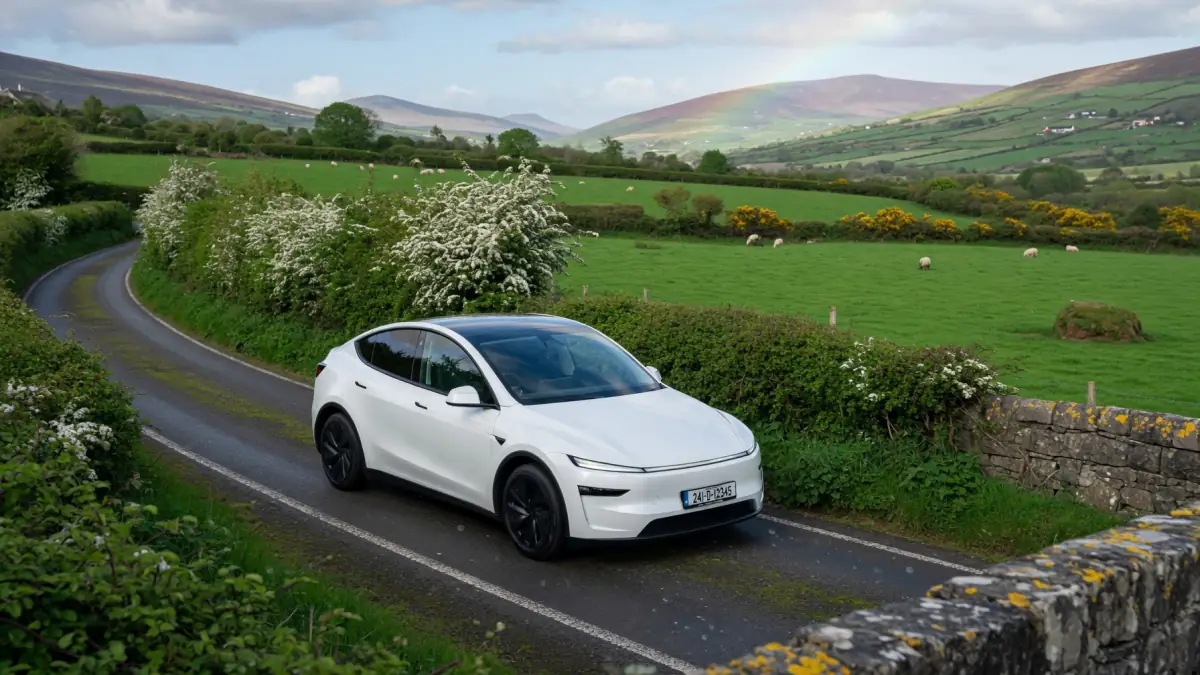
- Best overall — Kia EV3 (€36,790, 605 km Long Range, V2L, 7-yr warranty, World Car of the Year 2025).
- Best value — Hyundai Inster (€19,595, the only sub-€20k mainstream new EV in Ireland in 2026).
- Best family EV — VW ID.4 (€42,395, full VW dealer network all 26 counties, 1,200 kg towing rare in segment).
- Best for long trips — Tesla Model Y LR (Supercharger network) or Hyundai Ioniq 5 LR (800 V architecture, 18-min 10–80% on a 350 kW charger).
- Best company-car (BIK) — Tesla Model 3 LR or VW ID.4 — Cat A1 6–15% BIK + €30k OMV reduction = €5,000+/yr saving vs petrol equivalent.
- 2026 Irish EV registrations leaders: ID.4 (#1), Model 3 (#2), EV3 (#3), Model Y (#4), Inster (#5).
- Real running cost: ~€1,530/yr at 20,000 km on home night-rate charging — saves ~€2,400/yr vs petrol Tucson. Public-charging-only erodes 70%+ of that.
- Used EVs no longer qualify for SEAI grants but residuals stabilised in 2025 — 3-yr-old ID.4 €24–28k, Model 3 LR €27–34k.
The Irish EV context — 2026 is the inflection year
- 23,601 EVs registered in 2025 — up 35% year-on-year, surpassing the previous record set in 2023
- 18.89% of new car market share for full-year 2025
- Q1 2026: ~21.56% EV share — fastest powertrain transition in Irish motoring history
- Top 5 EV models in 2025: VW ID.4 (#1), Tesla Model 3 (#2), Kia EV3 (#3), Tesla Model Y (#4), Hyundai Inster (#5)
- Top 5 EV brands: Volkswagen, Kia, Tesla, Hyundai, Skoda
- SEAI grant up to €3,500 + VRT relief up to €5,000 — extended to 31 December 2026
- €120/year motor tax — lowest of any car category
- 2026 BIK Category A1 6–15% (vs petrol Cat C 21–37.5%) — saves €5,000+/yr for company-car drivers
- €30,000 OMV reduction stack on company-car BIK in 2026 (€10k universal + €20k EV-specific) — tapers from 2027, so 2026 is the peak
- Used EVs no longer qualify for SEAI grants (changed 2024) — incentives are new-vehicle only
For the full incentive breakdown see our SEAI EV Grants Ireland 2026 guide and our Company Car BIK guide.
The 10 best EVs ranked, by category
Ranked across three price tiers (city under €25k, affordable family €25–40k, mid-size and premium €40k+) so the right EV for your budget surfaces quickly. Within each tier picks are ordered by overall recommendation strength for the typical Irish private buyer in 2026.
City / first-time EVs (under €25k)
Hyundai Inster
World Car of the Year 2025 · #5 EV in Ireland 2025- Battery
- 42 kWh Standard or 49 kWh Long Range
- Range
- WLTP 327 km / 370 km · real-world 250–310 km
The genuinely good budget EV — proper Hyundai quality, V2L (vehicle-to-load) for plugging in tools / appliances / camping kettle, 5-year unlimited mileage Hyundai warranty + 8-year battery warranty, full Hyundai dealer network in every county. Best for: second car, urban commuter, anyone who would otherwise be looking at a budget petrol hatchback.
Not fast on motorways (modest 0–100 km/h, ~145 km/h top), smaller boot than rivals, peak DC charging only 85 kW (10–80% in ~30 min).
Dacia Spring Extreme
- Battery
- 26.8 kWh
- Range
- WLTP ~225 km · real-world 170–200 km
The cheapest new EV in Ireland. Properly basic but it works for a 30 km commute and a school run. Light kerb weight (~1,000 kg) makes it efficient at urban speeds; insurance is correspondingly cheap.
AC charging only at 7 kW, slow public DC, sparse interior, dated dynamic-control setup, 1-star Euro NCAP rating (2024) — for some buyers a deal-breaker.
BYD Dolphin Surf
- Battery
- 32 kWh
- Range
- WLTP ~310 km · real-world 220–250 km
Tech-heavy interior at the price (rotating tablet screen, lots of safety kit), Blade Battery LFP cell-to-body chemistry (more durable than NMC, can charge to 100% routinely), 6-yr / 150,000 km BYD warranty + 8-year battery warranty.
BYD dealer network in Ireland still building out (~5–7 dealers via Motor Distributors Ltd vs Toyota 70+, Hyundai 30+), residual values for new Chinese-brand EVs still establishing in the Irish market.
Affordable family EVs (€25k–€40k)
Kia EV3
World Car of the Year 2025 · #3 EV in Ireland 2025- Battery
- 58.3 kWh Standard or 81.4 kWh Long Range
- Range
- WLTP 436 km / 605 km class-leading · real-world 350–520 km
The best-value family EV in Ireland in 2026 — Kia 7-year unlimited warranty (transferable, adds €1k–€2k at resale), strong Irish dealer network in every county, V2L standard across the range, the only mainstream small-SUV-class EV with a 600 km+ WLTP option.
A bit boxy in styling (subjective), suspension firm on rough Irish surfaces, heat pump only on GT-Line S — meaningful for Irish winters where a heat pump cuts winter range loss from 30%+ to 15–20%, factor in the upgrade cost.
- Battery
- Urban 43/54 kWh LFP · classic ~51/64/77 kWh
- Range
- Urban LR up to 416 km WLTP · classic SR ~350 km · real-world 280–360 km typical
Ireland’s value EV hatch — new FWD Urban for price/boot/heat pump, classic RWD MG4 for driver’s feel, MG 7-year warranty, XPower performance special optional.
MG dealer network thin in rural Ireland (improving but still well below mainstream), parts availability slower than Toyota / Hyundai / Kia, infotainment software occasionally laggy, residuals lag established brands by 8–14 percentage points at 3 years. Two different cars share the MG4 badge — don’t mix them up.
- Battery
- 55 kWh or 77 kWh
- Range
- WLTP 388 km / 549 km · real-world 300–450 km
The mainstream "Golf-replacement" EV — solid, well-built, very few quirks now that the early software issues are fixed by the 2023 facelift / Mk1.5 update. Most-grant-claimed sub-€60k EV in Ireland (Pure under €40k OMV gets max VRT relief). Full VW dealer network and dealer service stamp protects residuals.
Rear seat space is tight for the size of the car, boot smaller than ID.4, peak DC 170 kW (Pro post-update; Pure 120 kW) — moderate vs 800 V Korean rivals.
Mid-size EVs (€40k–€55k)
Volkswagen ID.4
#1 EV in Ireland 2025 (third year running)- Battery
- 77 kWh or 82 kWh
- Range
- WLTP 520 km / 545 km · real-world 400–470 km
The default Irish family EV. AWD GTX variant available, towing capacity 1,200–1,400 kg (rare for EVs at this price), 2024 OTA software update raised Pro 77 kWh DC charging from 135 kW to 175 kW. Full VW dealer network all 26 counties is the residual-value tailwind.
Software still occasionally glitches even post-2024 update, suspension can be firm, no frunk (vs Tesla Model Y 117 L), heat pump option €700–€1,000 worth specifying for Irish winters.
Tesla Model Y
World's best-selling car 2023 + 2024 · #4 EV in Ireland 2025- Battery
- 64 kWh Standard · 75 kWh Long Range AWD
- Range
- WLTP 455 km / 605 km · real-world 380–520 km
Tesla Supercharger network (15+ Irish locations, fastest reliable DC charging in Ireland, 45–65 c/kWh and now open to non-Tesla via app) is a genuine long-distance advantage. 854 L boot largest in segment + 117 L frunk. 2025 Juniper refresh fixed most prior build-quality complaints. New Charlestown Dublin showroom opening autumn 2026.
Build quality historically variable (Juniper improved tightness), ride firm pre-Juniper, no Apple CarPlay or Android Auto by design, Tesla service network just two centres (Cork + Sandyford Dublin) plus mobile vans — vs VW 35+ dealers / Hyundai 30+ / Kia 25+.
Tesla Model 3
#2 EV in Ireland 2025- Battery
- 60 kWh LFP RWD · 75–82 kWh NMC Long Range / Performance
- Range
- WLTP 513 km / 678 km · real-world 370–490 km
Very efficient (Cd 0.22 lowest production-car drag), saloon body suits some buyers more than SUVs, Highland refresh (2023) transformed the cabin and acoustic glass. The "EV that legitimised the EV" — best-balanced overall package for daily driver + occasional long trip.
Low-slung — getting in / out is harder than Model Y; less boot space (594 L vs Y 854 L); same Tesla service-network limitation as Y; same no-CarPlay / no-Android-Auto by design.
Premium / long-range (€45k+)
- Battery
- Facelift 84 kWh · Irish shortlist RWD
- Range
- WLTP up to 570 km (Stellar 19″) · ~515–530 km on 20″ · real-world ~390–485 km
Ireland’s living-space EV — flat floor, Universal Island, 800V ~18-min charging, Stellar undercuts EV6 Earth, dense Hyundai dealer network, Parametric Pixel design presence.
V2L only from N Line up (not on Stellar), 20″ wheels tax range, Hyundai 5-year unlimited mileage (not Kia’s 7-year), current Irish facelift stock is RWD-focused — don’t assume UK AWD / N pricing.
Also shortlist in 2026 — Škoda Elroq & Enyaq
Since this top-10 ranking was first published, Skoda's MEB twins have become impossible to ignore on Irish EV sales charts. Elroq is SIMI's #5 EV model YTD 2026; Enyaq is #3. Both share the ID.3 / ID.4 platform with Simply Clever packaging and a dense Skoda dealer network — worth shortlisting even if they sit just outside the original top 10.
Škoda Elroq
SIMI #5 EV YTD 2026 · compact MEB SUV- Battery
- 50 / 60 / 85 packs · Selection 85: 82 kWh gross / 77 kWh net
- Range
- WLTP up to 573 km (Selection 85) · real-world ~430–480 km mixed
The compact Skoda EV you buy when you want VW-Group SUV packaging under the Enyaq — grant-friendly ROTR band, 470 L boot, Simply Clever storage, and Skoda dealers in most counties. Selection 85 is the coherent only-car buy; add the €1,271 heat pump for Irish winters.
Vehicle warranty is 3 yr / 150,000 km (optional 5-yr extension) — shorter than Kia's 7-year EV3 story. Heat pump is optional, not standard. Sportline / RS trims often lose the SEAI story on the August 2026 list.
Škoda Enyaq
SIMI #3 EV YTD 2026 · bigger MEB family SUV- Battery
- 60 / 85 packs · Selection 85: 82 / 77 kWh
- Range
- WLTP up to 575 km (Selection 85 SUV) · real-world ~430–470 km mixed
The bigger Skoda MEB twin — 585 L boot, cabin cleverness that usually beats ID.4 for family load-out, and Ireland's #3 EV sales chart. Selection 85 + heat pump is the private-buyer sweet spot; Selection 60 is the last clear SEAI-eligible rung after the July 2026 €50k ceiling.
Selection 85 typically sits past the new €50k SEAI ceiling (confirm dealer OMV). Heat pump still €1,271 optional. Coupé / RS are lifestyle steps, not the TCO play.
Best-of by use case (decision framework)
- Best overall — Kia EV3 (price + 7-yr Kia warranty + 605 km range + V2L)
- Best value — Hyundai Inster (sub-€20k for a genuine new EV from a mainstream brand)
- Best family EV — VW ID.4 (proven, big boot, 1,200 kg towing, full dealer network)
- Best for long trips — Tesla Model Y LR (Supercharger network) or Hyundai Ioniq 5 LR (800 V 18-min DC charge)
- Best company-car (BIK) — Tesla Model 3 LR or VW ID.4 — Category A1 BIK saves €5,000+/yr vs petrol equivalent in 2026
- Best driver's EV — Tesla Model 3 Performance or MG4 RWD
- Best for towing — VW ID.4 (1,200 kg), Kia EV6 GT-Line AWD (1,800 kg), Tesla Model Y (1,600 kg)
- Best Chinese-brand value play — BYD Seal in saloon class, BYD Dolphin Surf in city EV
- Best Skoda MEB pick — Elroq for compact value / grant band; Enyaq for bigger family boot (#3 EV YTD)
- Best PHEV alternative — see our family-cars guide for the Tucson PHEV / C-HR PHEV / Tiguan eHybrid options if you want home-charging convenience without full-EV commitment
Real running cost — VW ID.4 vs Hyundai Tucson 1.6 petrol, 20,000 km/yr
The honest side-by-side maths most articles skip:
- VW ID.4 (home night-rate charging, 17 kWh/100 km, €0.15/kWh)
- Electricity: €510/yr
- Motor tax: €120/yr
- Insurance: ~€700/yr
- Servicing: ~€200/yr (no oil, fewer wear parts; brake fluid every 2 yrs, 12V battery yr 4–5)
- Total: ~€1,530/yr · 7.7 c per km
- Hyundai Tucson 1.6 petrol (6.5 L/100 km, €1.91/L)
- Fuel: ~€2,483/yr
- Motor tax: €280/yr
- Insurance: ~€700/yr
- Servicing: ~€450/yr (oil, filters, more frequent intervals)
- Total: ~€3,913/yr · 19.6 c per km
The maths above assumes home night-rate charging. For drivers who rely 50%+ on public DC at 56–67 c/kWh, the saving collapses to €500–€800/yr. Public-charging-heavy ownership erodes 70%+ of the EV running-cost advantage.
Charging infrastructure (April 2026)
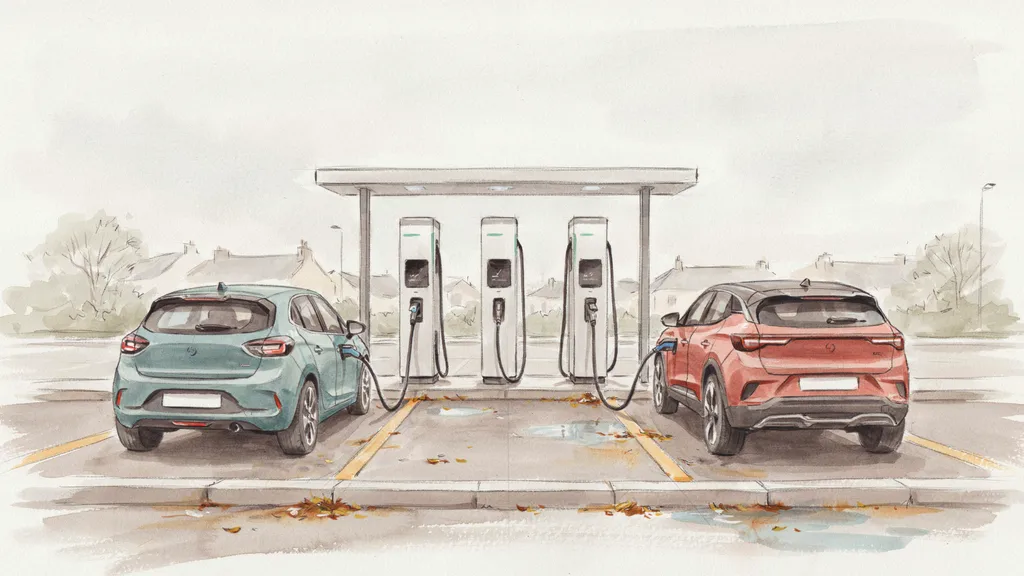
- Home night-rate: 12–18 c/kWh standard; some EV-specific tariffs (Pinergy) as low as 5.45 c/kWh on a tightly-defined window. Typical full charge €4–€8.
- ESB ecars 50 kW DC: 56–62 c/kWh
- ESB ecars 150 kW+: 60–67 c/kWh
- Ionity: 69–75 c/kWh ad-hoc / 39–49 c/kWh on subscription
- Tesla Supercharger: 45–65 c/kWh (open to non-Tesla via the Tesla app)
- Applegreen Electric: 56–65 c/kWh
- EZO / Weev / Brite / Circle K: 55–70 c/kWh range
- AFIR rules from June 2026: contactless payment mandatory at all DC chargers above 50 kW — no more app-only or RFID-only public DC
For the full network-by-network breakdown including reliability data, see our EV Public Charging Networks guide. For home charger installation costs, MPRN questions and the SEAI €600 Home Charger Grant, see our EV Home Charging guide.
What to consider before buying any EV in Ireland
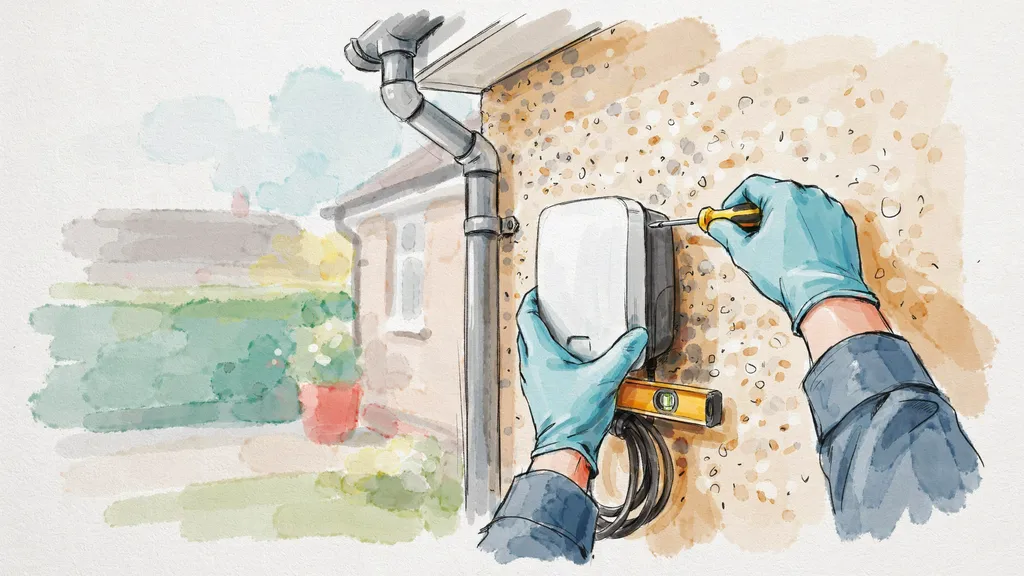
- Home charging access — without it, Irish public-charging costs erode 70%+ of the running-cost saving. If you can't install a wallbox, an efficient hybrid is usually the better answer until on-street public charging matures.
- Real range vs WLTP — assume 75–85% of WLTP in summer, 65–70% in winter. Specify a heat pump if available — it cuts winter range loss from 30%+ to 15–20%.
- Insurance — EVs are still 5–15% MORE expensive to insure than the equivalent ICE car in Ireland (opposite to the UK where the premium has flipped). Compare quotes carefully.
- Resale value — used EV market stabilised in 2025; 3-year-old EVs now ~11% below equivalent diesel residuals (vs 25%+ in the 2023–2024 collapse). Used EVs no longer qualify for SEAI grants but VRT relief was already applied at first registration.
- Battery warranty — typically 8 years / 160,000 km / 70% State of Health. State of Health report should be requested at any used EV purchase.
- Service costs — lower (no oil, fewer wear parts) but tyres wear 10–15% faster, brake fluid still every 2 years, 12V battery is the #1 EV breakdown cause in Ireland (per AA Ireland) — replace at year 4–5.
- For deeper detail see our Used EV Buying Guide and EV Battery Replacement Ireland guides.
2026 incentives — peak year
- SEAI Purchase Grant up to €3,500 — new BEVs €14,000–€60,000 OMSP
- VRT relief up to €5,000 — full on BEVs at or below €40,000 OMSP, taper to €50,000
- €120/year motor tax — flat lowest band on all BEVs
- BIK Category A1 6–15% — vs petrol Cat C 21–37.5% — saves €3,500–€6,000+/yr for a typical company-car driver
- €30,000 OMV reduction stack on company-car BIK in 2026 (€10k universal + €20k EV-specific). The €20k EV-specific reduction tapers from 2027
- SEAI Home Charger Grant up to €600 + €1,200 apartment supplement
- Home charger BIK exemption (employer-installed, employer retains ownership, BEV only) — since 1 January 2025; see our Workplace EV Charging guide
- LEVTI 50% toll discount on M50 / Dublin Tunnel for BEVs
The €20,000 EV-specific OMV reduction tapers from 2027, the SEAI grant + VRT relief framework is guaranteed only to 31 December 2026, and BIK Category A1 rates are at their lowest. Buyers shopping in late 2026 with a vehicle ordered for 2026 registration get the full peak-year stack; deferring into 2027 costs €1,500–€3,500 in lost tax efficiency for a typical company-car BEV.
Track your EV in odo.ie — kWh per 100 km, home vs public charging mix, total cost per kilometre. Most Irish EV drivers significantly underestimate their running cost when public charging is in the mix. odo.ie shows the truth.
odo.ie keeps your EV charging logs, service history, NCT reminders, motor tax and insurance dates in one place — built specifically for Irish drivers, with kWh-aware fuel logs, the SEAI Home Charger Grant tracker, and BIK-ready exports. Solo free for 1 vehicle; Family €4/month for 3 vehicles with co-driver sharing; Pro €8/month for 10 vehicles with Revenue-ready trip logbook. 120+ Irish guides, no ads, EU data residency.