ESB ecars is Ireland's largest network — over 1,400 charge points, PAYG at €0.59/kWh AC and €0.64/kWh DC, or €4.79/month membership that drops DC to €0.59/kWh. EZO(formerly EasyGo) is the cheapest DC option at from €0.50/kWh, contactless PAYG only. Ionity is the premium ultra-rapid network — €0.81/kWh PAYG, but annual subscriptions cut that to €0.39/kWh. Tesla Supercharger is open to all EVs, PAYG €0.57–€0.64/kWh or €0.42–€0.47/kWh with a €12.99/month membership. For most Irish EV drivers, the right mix is home charging for 80%+ of kmand a cheap DC network (EZO, Weev off-peak, or ESB Member) for long trips. Track your real cost per km in odo.ie so the maths stays honest.
How public charging actually works in Ireland
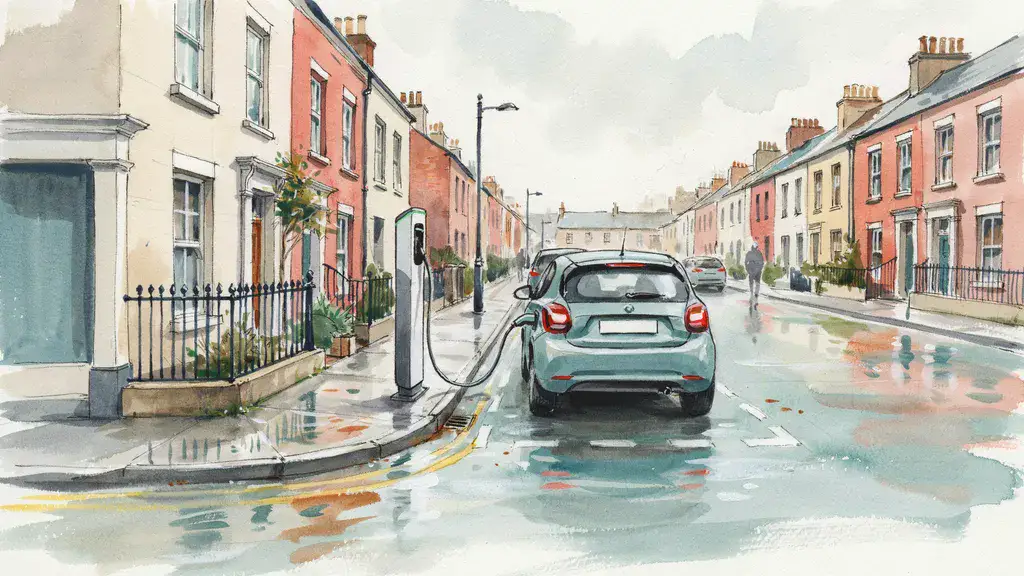
Every public EV charger in Ireland is run by a Charge Point Operator (CPO). The CPO owns the hardware, sets the price, runs the payment system, and is the company whose logo is on the charger. Ireland has roughly 1,900 public chargers across 800 sites, operated by nine major CPOs and a scattering of smaller players. ESB ecars dominates — it owns infrastructure the others simply can't match — but competition has pushed prices and service quality up significantly in the last two years.
The typical flow is:
- Find a charger using an app or a navigation tool (Zapmap, PlugShare, Google Maps, or the CPO's own app)
- Authenticate with either the CPO's app, an RFID card, or contactless bank card
- Plug in — the charger and car shake hands and agree on power
- Charge — you're billed per kWh delivered (sometimes plus a connection/session fee)
- Unplug and move the car promptly — idle fees can be brutal
The typical Irish EV commuter uses ESB ecars for everyday top-ups, EZO or Tesla for cost-optimised rapid charging, Ionity or Applegreen Electric for motorway service-station stops, and home charging for the bulk of daily km. There's no single "best" network — it depends on where you drive.
AC vs DC charging — the most important distinction
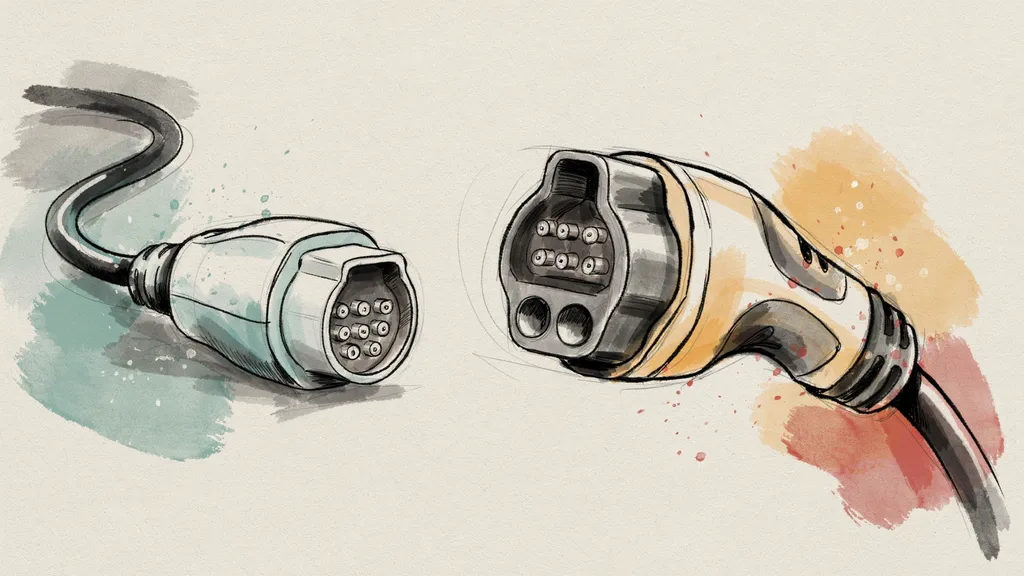
Every Irish public charger falls into one of two categories, and the split drives both cost and how long you'll be sitting there:
| Type | Power | Typical time | Typical cost | Best used for |
|---|---|---|---|---|
| AC — Slow | 3.7 kW | 8–12 hours | Low | Overnight street charging |
| AC — Fast | 7–22 kW | 2–6 hours | €0.45–€0.59/kWh | Work, shops, hotels, hubs |
| DC — Rapid | 50 kW | 40–60 minutes | €0.50–€0.64/kWh | Mid-journey top-up |
| DC — High-power | 100–150 kW | 20–30 minutes | €0.57–€0.70/kWh | Motorway service stations |
| DC — Ultra-rapid | 175–400 kW | 10–20 minutes | €0.59–€0.81/kWh | Long-distance driving |
AC (alternating current) chargers deliver power that your car's on-board charger has to convert to DC before it reaches the battery. That on-board converter tops out at 7–22 kW depending on the car, which is why AC always feels slower.
DC (direct current) chargers do the conversion inside the charger itself and deliver straight to the battery, bypassing the car's limit. That's how you get those 20-minute 10-to-80% charges. The hardware costs 5–10× more than AC, which is why DC electricity per kWh costs more.
Every Irish charging network, side by side
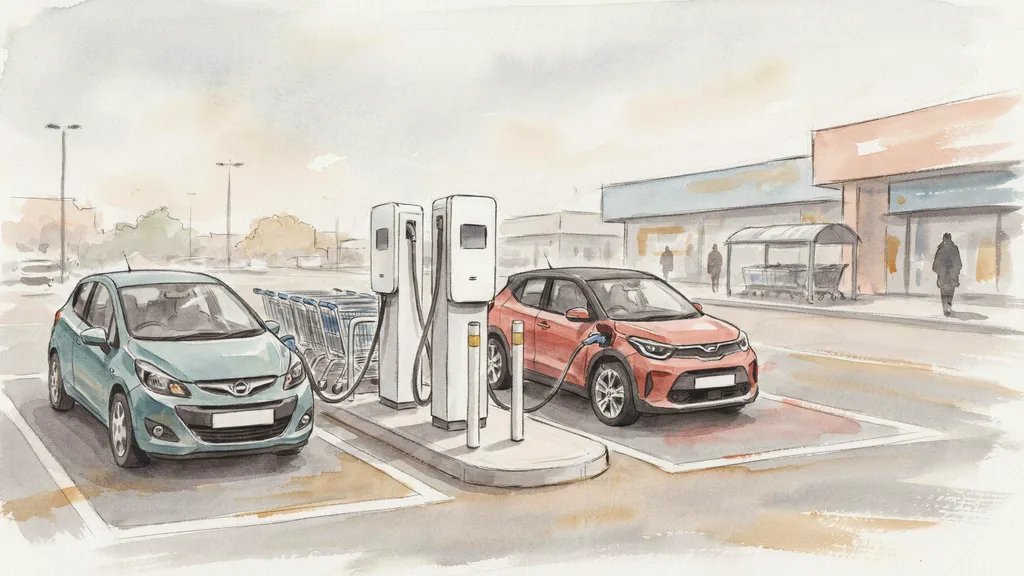
Below is every major Charge Point Operator in the Republic of Ireland. ESB ecars, EZO, Ionity, Weev and ePower were re-checked against their own tariff pages on 3 August 2026; Tesla and Applegreen are shown at their last confirmed rates (see the note under the table). Prices are standard residential/consumer rates — business and fleet accounts differ.
| Network | AC PAYG | DC PAYG | Membership | Scale in IE |
|---|---|---|---|---|
| ESB ecars | €0.60/kWh | €0.72/kWh | €4.79/mo → AC €0.55 / DC €0.67 | 1,400+ points |
| EZO (formerly EasyGo) | from €0.45/kWh | from €0.50/kWh + €0.27 connection fee | None — PAYG only | Nationwide |
| Ionity | — | €0.81/kWh | Free app: €0.47/kWh Power: €11.99/mo → €0.46/kWh Power 365: €99.99/yr → €0.47/kWh Motion 365: €49.99/yr → €0.59/kWh | Motorway hubs |
| Tesla Supercharger | — | €0.57–€0.64/kWh* | €12.99/mo → €0.42–€0.47/kWh | 60 → 124 stalls by Summer 2026 |
| Applegreen Electric | Varies | ~€0.50–€0.69/kWh | App discounts | Motorway network |
| Circle K | — | Displayed at station | — | 41 locations, 134 points |
| Weev | €0.55/kWh app €0.60/kWh contactless | €0.66/kWh app €0.71/kWh contactless | App rate is the discount | Cross-border NI/ROI |
| Brite | — | Displayed at station | — | Galway hub, West of Ireland |
| ePower | €0.47/kWh† | €0.66/kWh† | eVeryday app €4.79/mo | Aldi & retail sites; 200 chargers rolling out with the four Dublin councils |
*Tesla Supercharger non-Tesla PAYG prices vary by time of day — 57¢ off-peak, 64¢ peak. Tesla's Irish tariff page could not be re-read on 3 August 2026, and Applegreen has rebranded to Applegreen Fast Charge without a public pricing page, so both rows are last-confirmed figures rather than same-day verified — check in-app before relying on them. †ePower rates are those published for its eVeryday app; it does not publish a separate pay-as-you-go tariff.
ESB ecars — the default
The default Irish network for a reason — it's simply everywhere. Over 1,400 charge points nationwide, mix of AC and DC, and a target of 3,000 points by 2030. PAYG is €0.60/kWh AC and €0.72/kWh DC; the €4.79/month membership drops that to €0.55 and €0.67 and pays for itself with roughly two full DC top-ups a month (12-month minimum term). Minimum €5 balance and a €20 initial top-up required to start. Contactless on high-power chargers at the PAYG rate.
EZO — the value pick
Formerly EasyGo, now rebranded as EZO, with prices starting from €0.45/kWh AC and €0.50/kWh DC plus a €0.27 connection fee. Crucially, EZO is contactless PAYG only — no membership, no app required, just tap a card. That makes it the easiest network to start using and usually the cheapest for DC charging on a per-session basis.
Ionity — the premium ultra-rapid network
Built by a joint venture of BMW, Mercedes, Ford, Hyundai-Kia and Volkswagen to rival Tesla. The largest Irish Ionity hub is at Charlestown (Dublin) with ultra-rapid 350 kW stalls. Ad-hoc is steep at €0.81/kWh — but simply using the Ionity app drops it to €0.47/kWh with no subscription at all, which is the single best trick on this page. Paid plans only beat that marginally: Power at €11.99/month gives €0.46/kWh, Power 365 at €99.99/year gives €0.47/kWh, and Motion 365 at €49.99/year gives €0.59/kWh. Unless you charge very heavily on Ionity, the free app rate is the one to use.
Tesla Supercharger — now open to all
Most Tesla Superchargers in Ireland are open to non-Tesla EVs. Non-Tesla PAYG is €0.57–€0.64/kWh depending on time of day (demand-based pricing). A €12.99/month membership drops that to €0.42–€0.47/kWh — the cheapest monthly DC membership on the Irish market if you use Tesla once a week or more. The network is expanding fast: 60 stalls across 9 sites in early 2026 growing to 124 stalls across 18 sites by summer 2026, according to Tesla's own announcements. Non-Tesla drivers need the Tesla app and an account with a payment card on file.
Applegreen Electric — motorway mainstay
Applegreen's own-brand EV charging network, rolled out across its motorway service areas. DC rapid chargers typically in the €0.50–€0.69/kWh band, with app-based discounts for regular users. Many Applegreen sites also host Ionity chargers as part of a co-branded buildout, so you can effectively pick between Applegreen's own tariff and Ionity's at the same location.
Circle K — super-fast hubs
Circle K operates its own charging network at 41 Irish locations (134 charge points total), with all chargers at minimum 100 kW and some super-fast hubs delivering up to 400 kW (Clonshaugh and City Avenue in Dublin). Circle K also hosts Ionity at several motorway sites. Pricing is displayed at the charger and in the app.
Weev — the cross-border option
Weev is primarily a Northern Ireland operator expanding into the Republic, with 25 rapid chargers being installed across border counties. Weev prices by charger type rather than by time of day: AC is €0.55/kWh in the app (€0.60 contactless) and rapid/ultra-rapid is €0.66/kWh in the app (€0.71 contactless). Useful for anyone living near the border or driving regularly between ROI and NI.
Brite — ultra-rapid in the west
Brite is a smaller Irish operator focused on the west of Ireland, with an ultra-rapid hub on Sandy Road in Galway. Handy for long journeys across Connacht where the other networks thin out.
ePower — Aldi car parks and the Dublin council rollout
Best known as a home charger and solar installer, ePower also operates its own public network — which is why you will meet the same brand in two very different places. Its most visible sites are in Aldi car parksaround the country, and it is rolling out 200 fast chargers across up to 50 locations in partnership with Dublin's four local authorities. Rates published for its eVeryday app are €0.47/kWh AC and €0.66/kWh DC, with the app costing €4.79/month. Check the rate shown in the app or on the unit before you plug in — ePower does not publish a separate pay-as-you-go tariff.
Confusingly, Energia and Electric Ireland are electricity suppliers, not public charging networks. They sell home EV tariffs (Energia EV Smart Drive, Electric Ireland EV Night Boost) that make home charging ultra-cheap, but they don't operate public chargers. ePower is the opposite case and catches people out the other way — it is best known for home charger, solar and battery installation, but it doesrun its own public network as well, so the same brand turns up in both places.
Membership vs PAYG — when each one pays off
Every network that offers a membership has a break-even point. Below that point, PAYG is cheaper. Above it, the membership wins. Here's the maths, using the current 2026 prices:
| Membership | Cost | Saving per kWh | Break-even |
|---|---|---|---|
| ESB ecars Member | €4.79/mo | €0.05/kWh (DC) | ~96 kWh/mo — roughly 2 full 50 kWh top-ups |
| Tesla Supercharger | €12.99/mo | €0.15–€0.17/kWh | ~80 kWh/mo — roughly 1.5 full top-ups |
| Ionity Motion 365 | €59.99/yr | €0.32/kWh vs PAYG | ~188 kWh/yr — ~4 full top-ups annually |
| Ionity Power 365 | €119.99/yr | €0.42/kWh vs PAYG | ~286 kWh/yr — ~6 full top-ups annually |
The picture: memberships pay off faster than most EV drivers think. If you do more than one long-distance motorway trip a month and Ionity is on your route, the Power 365 subscription pays for itself in the first long weekend away. ESB Member pays off if you're using ESB even semi-regularly for DC charging.
Which apps you actually need
Ten apps for ten networks is untenable. In practice, most Irish EV drivers settle on three or four:
- ESB ecars app — required for ESB membership, useful for PAYG too. Shows live charger status.
- Tesla app — required for non-Tesla Supercharger access and membership.
- EZO app — optional (EZO is contactless-only) but handy for finding chargers.
- Ionity app — required for the Motion 365 / Power 365 subscription rates. PAYG works contactless without the app.
- Applegreen Electric app — needed for app-based discounts.
- Zapmap or PlugShare — network-agnostic map apps that cover every CPO in one place, with live availability and crowd-sourced reliability reports. Essential for long-distance planning.
- Google Maps — now shows live charger status at most CPOs and routes you via available chargers.
If you want a minimal kit: ESB ecars app for the largest network, EZO via contactless for the cheapest DC, plus Zapmap or Google Maps to find them. Everything else you can add when you actually need it.
Overstay and idle fees — don't get caught out
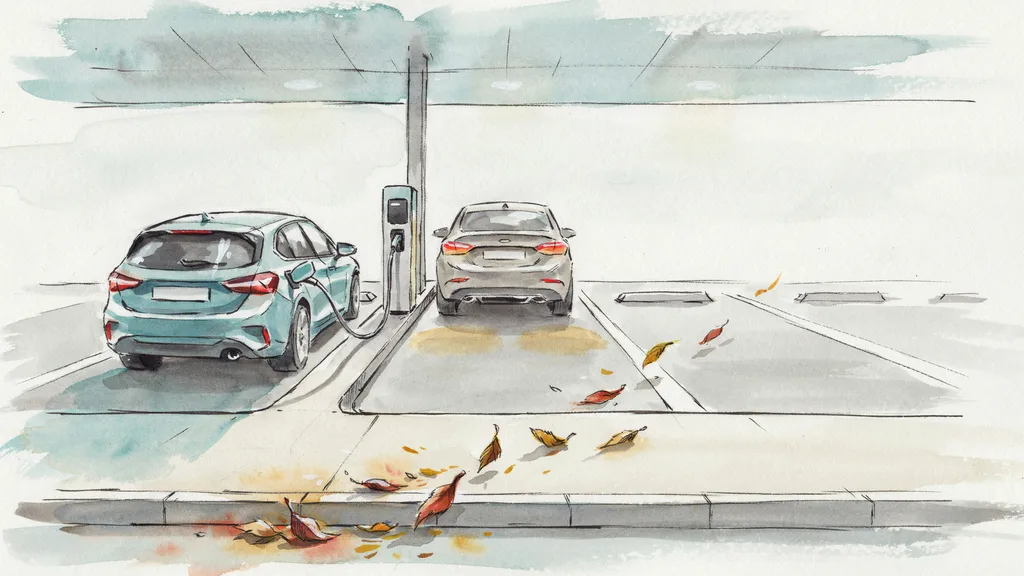
Every major DC network charges a per-minute idle fee if you leave your car plugged in after charging completes. These fees add up fast — faster than the charging itself — so treat them like a short-stay car park.
| Network | Grace period | Idle fee |
|---|---|---|
| ESB ecars (Fast / High-Power) | 45 minutes | €0.50/min |
| ESB ecars (Standard AC) | 10 hours | €0.50/min |
| Ionity | 10 minutes after charge complete | ~€0.25/min (varies) |
| Tesla Supercharger | 5 minutes after charge complete (when site ≥50% full) | €0.50–€1.00/min based on occupancy |
€0.50 per minute is €30/hour — well above Dublin city-centre parking. If you're plugging in while you grab lunch, set a phone alarm 5 minutes before charging is due to complete and get moving.
Contactless payment and the AFIR rule
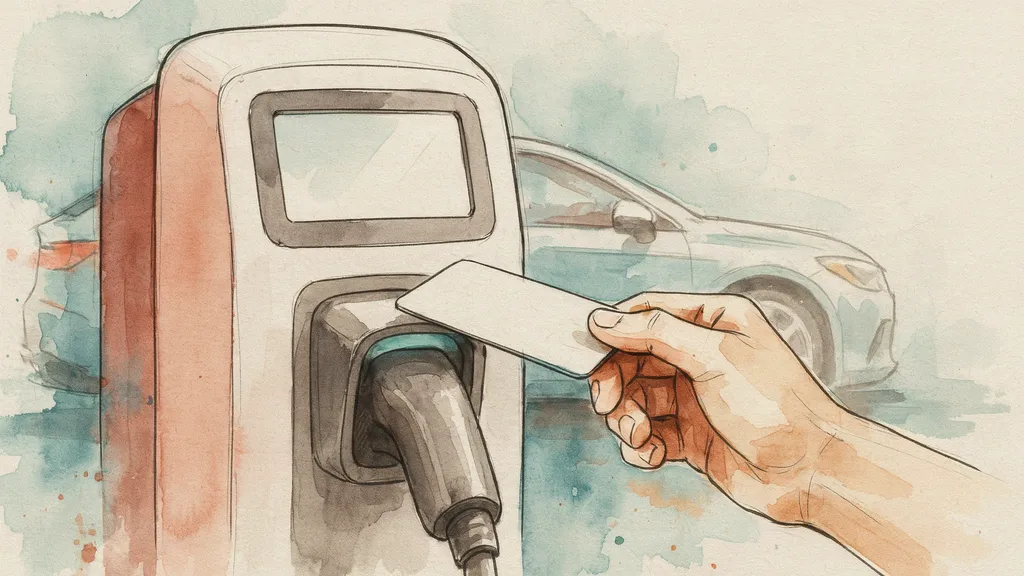
Historically, most Irish public chargers required either the CPO's app or an RFID card. That's changing fast under the EU Alternative Fuels Infrastructure Regulation (AFIR, 2023/1804), which has directly reshaped Irish public charging since it came into force in April 2024.
AFIR requires, for new chargers:
- Contactless payment at every DC charger rated 50 kW or above — bank card, phone NFC, or similar ad-hoc payment. No app account required.
- Price-per-kWh transparency — the price must be clearly displayed at the charger before you plug in.
- ISO 15118 support (mandatory from January 2026) — the Plug & Charge standard that lets the car auto-authenticate with the charger.
- DATEX II open data — from 14 April 2026, operators must publish real-time availability and price data that third-party apps (Zapmap, Google Maps) can pull into their maps.
For drivers, the upshot is simpler: newer high-power chargers accept a tap of any bank card, prices are clearly displayed, and apps show live status accurately. Older chargers without contactless are being retrofitted or replaced, though there's still a long tail of app-only DC chargers out there. Carry a bank card and at least one charging app as a backup.
Dynamic tariffs — arriving 30 June 2026
A major change is coming on 30 June 2026. Following a CRU decision in September 2024, the five largest Irish electricity suppliers — Electric Ireland, SSE Airtricity, Bord Gáis Energy, Energia and PrePay Power/Yuno — must each offer a standard dynamic tariff. That means domestic electricity prices will update every 30 minutesbased on wholesale market prices, rather than the fixed day/night split we've had for decades.
Dynamic tariffs mainly affect home charging. When wind generation is high and demand is low (typically late night), wholesale prices can collapse to a few cents per kWh. Smart EV chargers that schedule around the cheapest 30-minute windows can cut EV electricity costs to €0.02–€0.08/kWh in favourable weather — from €810 a year on a standard rate down to as little as €45–€180 a year. Over 1.9 million Irish homes already have smart meters installed, which is the prerequisite.
Public charger prices are not directly tied to dynamic tariffs — each CPO sets its own rates. But expect indirect effects: CPOs will negotiate cheaper wholesale deals, some may start publishing their own time-of-day pricing (Weev already does 22:00–07:00 off-peak), and overall pressure on public rates should bias downwards as competition intensifies.
Home vs public — keep the split right
The economics here are simple and almost never change: home charging is 5–10× cheaper per kWh than public charging. Home EV tariffs bottom out around 6–12¢/kWh on a dedicated overnight window (Pinergy EV Drive Time, Bord Gáis EV Smart, Energia EV Smart Drive). Public DC charging runs €0.50–€0.81/kWh. That's a 5–13× gap.
The right framing for anyone considering an EV:
- If you have off-street parking — home-charge for daily km, treat public as a holiday / long-trip tool. Annual charging spend typically €250–€500.
- If you don't have off-street parking — public charging becomes the main source. Annual spend €1,200–€2,400 depending on km. The financial EV case weakens, though running-cost parity with diesel still usually holds at typical km.
- If you're border-adjacent — Weev off-peak gives DC access at home-charging-adjacent rates.
See our EV home charging in Irelandguide for SEAI grant details, installation costs and tariff comparisons. Our petrol vs diesel vs EV comparison runs the total annual cost of each fuel type side by side.
10 tips to cut public charging costs in Ireland
- Charge at home wherever possible — the 5–13× gap to public is the single biggest lever in EV economics.
- Pick the cheapest DC network on your route — EZO for PAYG, Weev between 22:00 and 07:00, or ESB Member if you use ESB regularly.
- Use AC not DC whenever time allows — a 3-hour AC charge at €0.45/kWh costs roughly half what the same energy costs on DC.
- Join one membership, not all of them — pick the one that matches your highest-use network.
- For motorway driving, run the Ionity Power 365 numbers — for heavy motorway users, €119.99/year at €0.39/kWh is the cheapest long-distance rate in Ireland.
- Move the car the moment charging completes — idle fees at €0.50/min accumulate at €30/hour.
- Don't charge to 100% on DC — most EVs slow dramatically above 80%. Top up to 80% and keep rolling, or finish the last 20% on cheaper AC.
- Track your real cost per km — log every session and spot expensive patterns. odo.ie's fuel logger handles this for kWh as well as litres.
- Time long trips around off-peak — Weev, Tesla and some Applegreen sites flex their prices by time of day.
- Check chargepoint availability before you arrive — Zapmap, PlugShare and Google Maps show live status on most networks now, thanks to AFIR's open-data rule.
Track your charging costs per kWh in odo.ie's fuel logger — see your real cost per kilometre
odo.ie's fuel logger tracks every kWh you add — at home and in public — along with cost, location and odometer. Over time you'll see your true cost per kilometre, broken down by network, and catch expensive habits (a twice-weekly Ionity PAYG stop, an untouched ESB subscription) before they eat into your EV savings.