Irish plates follow YYY-CC-SSSSSS — year + half, county code, sequence. 261 = Jan–Jun 2026, 262 = Jul–Dec 2026 (the 1/2 split was introduced in 2013 to dodge "unlucky 13"). 26 county codesare currently in active use — D = Dublin, C = Cork, G = Galway, KY = Kerry, and so on. Since 1 July 2025, EVs can voluntarily display a green stripe on the left of the plate. Ireland does not permit personalised or vanity plates. Replacement plates cost €20–€40 from authorised suppliers. Plates stay with the car for its whole life — they are not transferable between vehicles.
The modern format — YYY-CC-SSSSSS, decoded
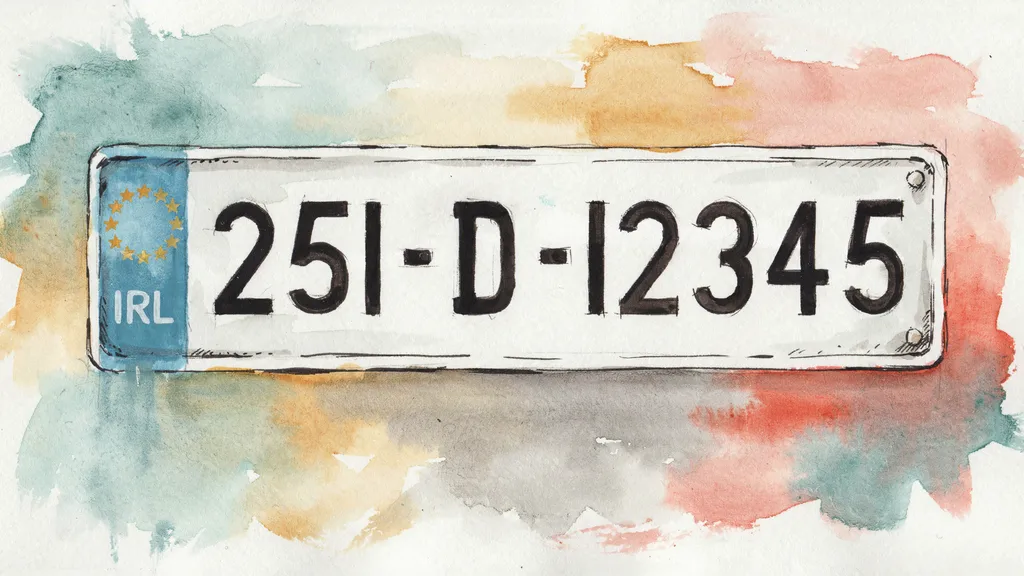
Every Irish registration plate issued since 2013 follows the same three-part structure:
| Part | Position | What it tells you | Example |
|---|---|---|---|
| Year + half | First | Year of registration and which half of the year | 261 |
| County code | Middle | County of first registration | D (Dublin) |
| Sequence | Last | Sequential number for that county + half-year | 12345 |
Combined: 261-D-12345 = the 12,345th vehicle registered in Dublin between January and June 2026.
The sequence number isn't padded — small numbers start at 1, 2, 3 (without leading zeros) and grow as more cars are registered in that county. A car plated 261-D-1 would be one of the very first vehicles registered in Dublin in January 2026.
The 1/2 split — why every year has two plates
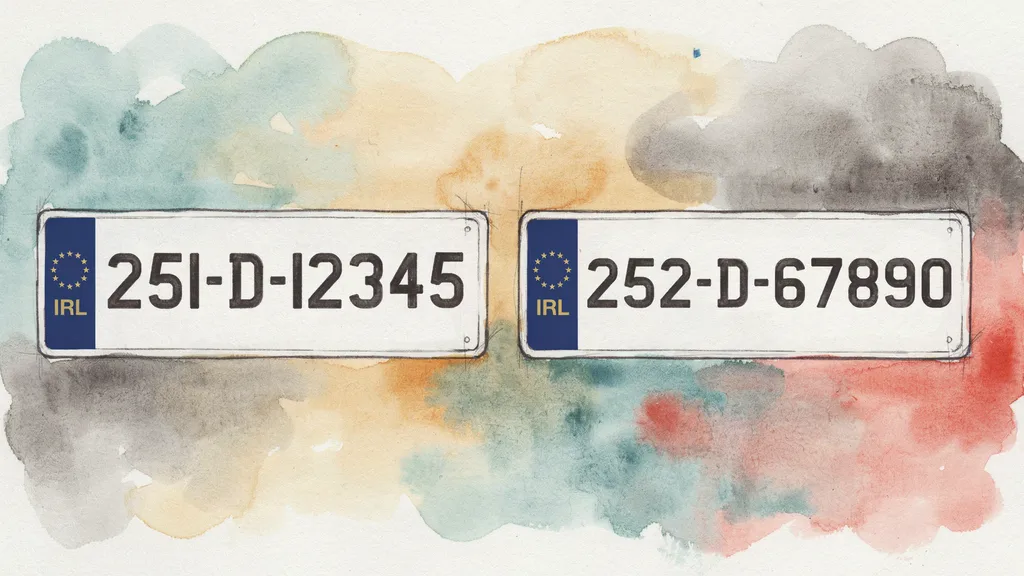
Before 2013, Ireland used a simple two-digit year: a car registered in 2012 had "12" in the plate, a car registered in 2013 would have had "13". Motor industry surveys in 2011 predicted this would depress new-car sales — buyers avoiding a "13" plate for superstition or resale reasons. The Government's fix was to introduce a half-year indicator:
- 131 for vehicles registered January–June 2013
- 132 for vehicles registered July–December 2013
The system has applied to every year since. So in 2026, plates beginning 261 are Jan–Jun, 262are Jul–Dec. In 2027 it will be 271 and 272, and so on.
The side-effect: July became a minor "new plate" season in Ireland. Dealerships now run marketing pushes twice a year — January for the primary new-plate release and July for the second — which subtly smooths out annual new-car sales across the calendar.
Every current Irish county code
26 codes are in active use on Irish plates. Some are single letters (larger cities and first-letter counties), others are two-letter codes where a single letter was already taken:
| Code | County / City | Region |
|---|---|---|
| C | Cork | Munster |
| CE | Clare | Munster |
| CN | Cavan | Ulster (ROI) |
| CW | Carlow | Leinster |
| D | Dublin | Leinster |
| DL | Donegal | Ulster (ROI) |
| G | Galway | Connacht |
| KE | Kildare | Leinster |
| KK | Kilkenny | Leinster |
| KY | Kerry | Munster |
| L | Limerick | Munster |
| LD | Longford | Leinster |
| LH | Louth | Leinster |
| LM | Leitrim | Connacht |
| LS | Laois | Leinster |
| MH | Meath | Leinster |
| MN | Monaghan | Ulster (ROI) |
| MO | Mayo | Connacht |
| OY | Offaly | Leinster |
| RN | Roscommon | Connacht |
| SO | Sligo | Connacht |
| T | Tipperary | Munster |
| W | Waterford | Munster |
| WH | Westmeath | Leinster |
| WW | Wicklow | Leinster |
| WX | Wexford | Leinster |
The code indicates where the car was first registered— not where it lives now. A car that was first registered in Cork and later sold to a Dublin owner keeps its C plate forever. That's why, in major cities, you'll see plates from every county — reflecting each vehicle's original registration location, not the current owner's address.
A few older codes have been merged or retired:
- WD — was used for Waterford County (distinct from W for Waterford City) before the two were merged into a single W code
- LK — was briefly used for Limerick before the single L code was standardised (Limerick uses L today)
- Various pre-1987 letter combinations — see the historical formats section below
Historical formats — before the current system
1987–2012: the two-digit year
From 1987 to 2012, Ireland used a simpler format: YY-CC-SSSSS — two-digit year, county code, sequence. A car registered in Dublin in 2005 would have been plated 05-D-12345. A 2010 Cork car would have been 10-C-54321.
This format applied for 26 years and produced roughly 4.5 million unique plates across the country. A vast share of cars still on Irish roads today — particularly older used cars — carry these two-digit-year plates.
Pre-1987: index-mark letter codes only
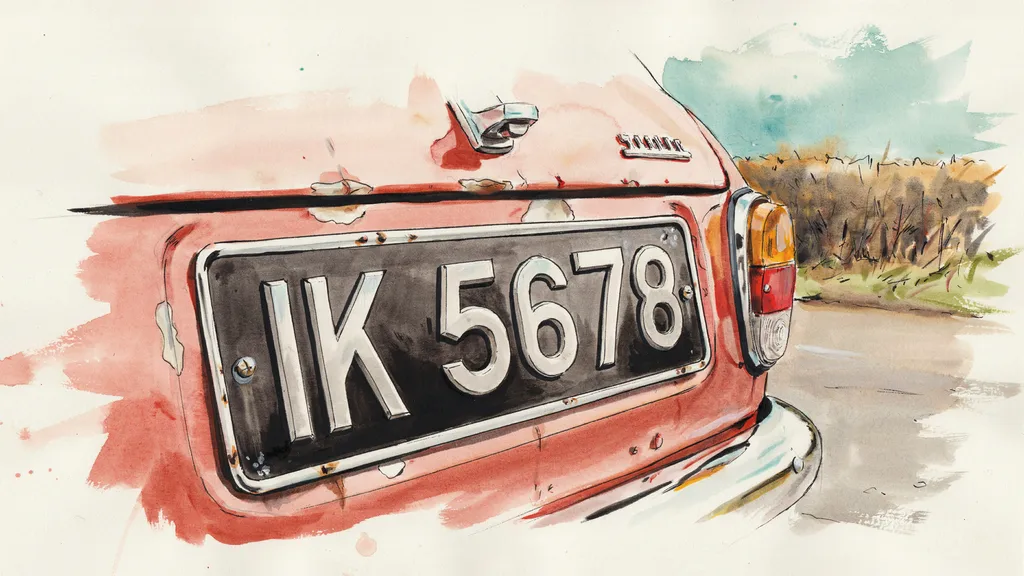
Before 1987, Irish plates didn't include a year at all. They used a letter index mark (identifying the registration district) followed by a sequential number — e.g. IK 1234 for Kilkenny. The registration system originates in the Motor Car Act 1903; vehicle registration has been mandatory in Ireland since that year.
The pre-1987 system was regional rather than chronological — dating such a car requires the VRC or the original registration records, not just the plate. You'll still see pre-1987 plates on vintage cars (typically 1970s or earlier).
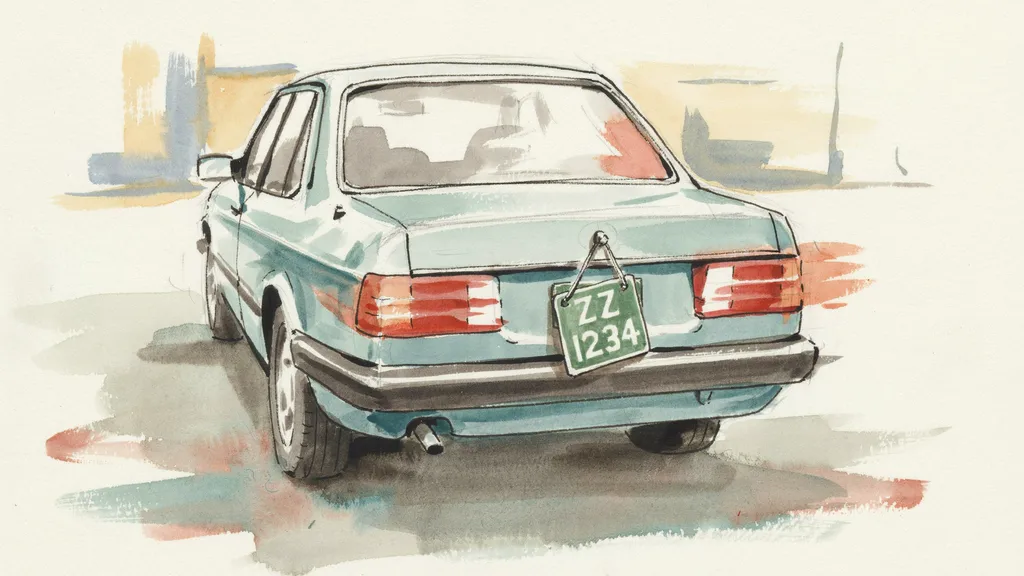
ZZ is not a pre-1987 county code — it was (and still is) a temporary export code for vehicles being taken out of Ireland by non-residents within one month of purchase. Similarly, ZV is a specific code for vintage vehicles registered under special arrangements, not a general pre-1987 format.
Green-flash zero-emission plates (since 1 July 2025)
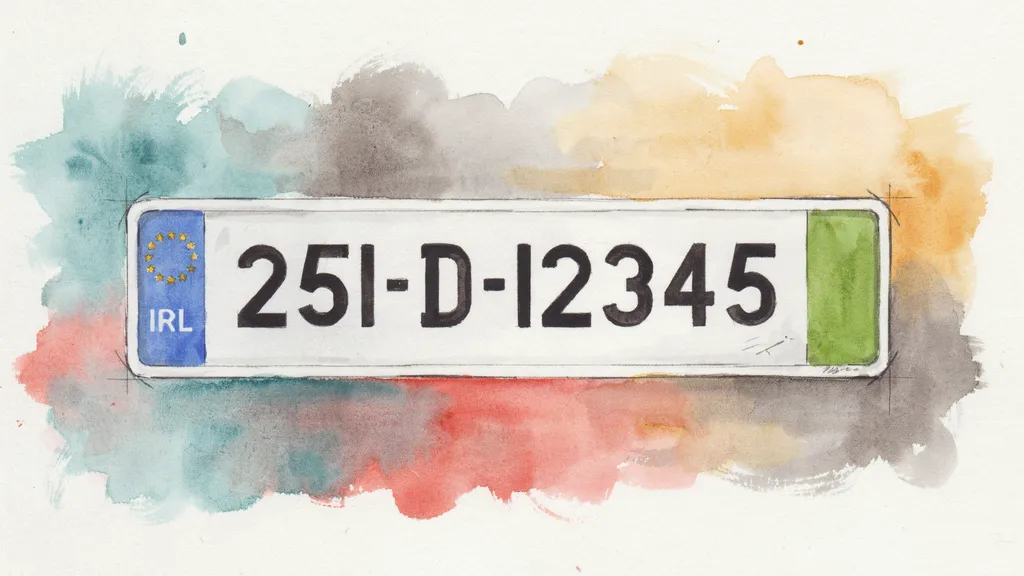
On 1 July 2025, under the Vehicle Registration and Taxation (Amendment) Regulations 2025, Ireland introduced an optional green identifier band on the right-handedge of the registration plate, for zero-emission vehicles. The standard EU blue band with gold stars and "IRL" remains on the left — the green band mirrors it on the right. On square plates, the green band sits below the IRL band. The blue EU band with "IRL" on the left remains mandatory on every plate.
The green flash is voluntary — BEV owners can opt in when ordering plates (at first registration or when replacing lost/damaged plates). Eligibility: vehicles with zero tailpipe emissions (BEVs today; hydrogen fuel-cell in future). Plug-in hybrids and mild hybrids are not eligible. The plate retains the standard YYH-CC-SSSSSS format; the only change is the visual marker. It does not alter road tax, tolls, insurance or any other commercial arrangement.
The policy purpose is to prepare Ireland for future Low-Emission Zones and to make zero-emission vehicles more visually distinguishable in traffic.
Personalised / vanity plates — not available in Ireland
Unlike the UK (which runs a lucrative DVLA auction of custom registrations), Ireland does not permit personalised or vanity plates. Every Irish plate is assigned sequentially by Revenue at first registration — you cannot put custom text or choose a different county code.
The closest thing — a "cherished number"
You can pre-reserve a specific sequence number via Revenue form VRT15A, for a fee of €1,000. The number will be assigned to your vehicle when the matching sequence comes up in that county's numbering. Popular for matching car model numbers — e.g. reserving 191-D-911 for a Porsche 911, or 181-C-63 for a Mercedes AMG 63.
Caveats: the reservation is specific to county and half-year (you can't pre-reserve across half-years), and the scheme has been withdrawn for used imports since 2015 — only vehicles being registered new for the Irish market qualify. The first number issued each year in Cork, Dublin, Limerick and Waterford is traditionally reserved for the city's Lord Mayor.
Other customisations permitted:
- The green band for BEVs (voluntary, since 1 July 2025)
- A Euro plate surround with the dealer or manufacturer name — purely cosmetic and optional
Attempting to display a custom plate (e.g. "MY CAR 1" in place of the issued registration) is a Road Traffic offence and an NCT fail.
Display rules and offences
Under the Road Traffic Acts, Irish plates must be:
- Displayed front and rear — both plates required, clearly visible
- Regulation font and size — specified by statute (a specific sans-serif, fixed character height)
- Reflective white on both front and rear plates
- Unobscured — not covered by mud, accessories, tow balls, bike racks (covering a plate when using a bike rack requires a secondary plate attached to the rack), frost, or tinted plastic
- Correctly formatted — YYY-CC-SSSSSS with dashes or spaces as appropriate (not "creative" spacing to form words)
- Matching the Vehicle Registration Certificate — the plate must match the VRC exactly
Common offences include using an "Italic" or "3D" font from a self-made plate supplier, obscuring a plate with a tow bar or bike rack, or displaying a UK-style font on an Irish plate. These are all NCT fail items and typically attract a Fixed Charge Notice on detection.
Replacement plates — cost and where to buy
Plates wear, get damaged, or go missing. Replacement must comply with the legal specification — but note there is no formal "authorised supplier" licensing schemein Ireland. Any supplier producing a compliant plate is acceptable; non-compliant plates fail the NCT and are an offence.
- Typical cost: €15–€30 per plate from most suppliers. Fitting (if needed) is usually ~€10 extra.
- What you need: your VRC (as proof of entitlement). Reputable suppliers ask to see the VRC before making plates.
- Common suppliers: motor factors (Halfords, Micks Garage), specialist plate makers near motor tax offices, main-dealer parts departments, and online suppliers.
- Lead time: typically while-you-wait (10–30 minutes) at specialist shops.
Self-made plates — printed at home, ordered from overseas, or altered to change the font — are illegal and will fail the NCT. Penalties: up to €5,000 fine on summary conviction, and since late 2024 Gardaí can issue a €60 Fixed Charge Notice directly for non-compliant plates. Driving with an illegible plate is a separate offence with similar escalation.
Trade plates — the white-on-green plates on dealer cars
Licensed motor traders use Trade Plates — white characters on a dark green background — to temporarily display on vehicles that haven't been permanently registered yet. You'll see them on:
- Brand-new cars moving from port to dealer
- Ex-demo cars being test-driven
- Imported cars en-route to registration
- Dealer-to-dealer transfers
- Repaired vehicles being returned to customers
The format reverses the standard order: trader serial number – county code – year (for example, 12345-D-26 for trader number 12345 based in Dublin operating in 2026). They are issued by the local authority to licensed motor traders — manufacturers, importers, dealers, repairers. Not available to members of the public; private drivers attempting to use trade plates is a serious offence.
Don't confuse trade plates with...
- ZZ plates — used for vehicles being temporarily exported by non-residents (e.g. a tourist buying a car in Ireland and shipping it home within a month). Administered by AA Ireland on behalf of Revenue.
- ZV plates — reserved for vintage vehicles (typically 30+ years old) registered under special arrangements.
Reading a plate to estimate a car's age
This is the single most useful practical skill for used-car buyers. At a glance, a plate tells you exactly when the car was first registered:
| Plate starts with | Year & half | Approximate age in 2026 |
|---|---|---|
| 261 / 262 | Jan–Jun / Jul–Dec 2026 | 0–1 year |
| 251 / 252 | 2025 | 0–1 year |
| 241 / 242 | 2024 | 1–2 years |
| 211 / 212 | 2021 | 4–5 years |
| 191 / 192 | 2019 | 6–7 years |
| 171 / 172 | 2017 | 8–9 years |
| 13, 12, 11… (two-digit) | Pre-2013 | 13+ years |
Combined with the odometer, a plate tells you whether the car's mileage is consistent with age. A 2019-plated car (about 7 years old in 2026) with 50,000 km has averaged well under 10,000 km/year — potentially low for its age, which could be attractive but also worth investigating (mileage-tampered? garaged?). A 2022-plated car with 150,000 km has been worked very hard — not inherently bad but reflected in price.
See our buying a used car in Ireland guide for a full inspection checklist and history check tips.
Add a car to odo.ie and we'll auto-detect year and county from the plate
When you add a vehicle to odo.ie, the app reads your registration plate and auto-fills the year of first registration and county code — saving you typing and getting the basics right from day one. From there, track service, fuel, NCT, tax and insurance in one place. Free for one vehicle, Family (€4/mo) for up to 3.