Calculator
Pick car or van, enter OMV, fuel type and CO₂ (or skip CO₂ for EVs) and business mileage. The breakdown shows every tax year from 2026 to 2029 side by side, so you can see how the OMV taper raises your BIK each year. The marginal-tax overlay turns the BIK figure into a real €/month out-of-pocket cost via PAYE + USC + PRSI.
What's new for 2026 — Category A1
From 1 January 2026, Revenue introduced a dedicated Category A1 for zero-emission vehicles (BEVs only). Previously, EVs sat in Band A alongside low-emission PHEVs and petrol cars under 60 g/km, paying 9–22.5% based on business mileage. The new A1 lowers those rates by roughly a third:
| Business km/yr | Old Band A (pre-2026) | New A1 (2026) | Difference |
|---|---|---|---|
| 0–26,000 km | 22.5% | 15% | −7.5pp |
| 26,001–39,000 km | 18% | 12% | −6pp |
| 39,001–48,000 km | 13.5% | 9% | −4.5pp |
| 48,001+ km | 9% | 6% | −3pp |
On a €50,000 EV with €30,000 OMV reduction (taxable OMV €20,000) and 35,000 business km, the BIK fell from €3,600/year (18%) to €2,400/year (12%) — a €1,200 annual saving from the rate change alone, before factoring in the OMV reduction stack.
The OMV reduction stack & the 2026–2029 taper
Two OMV reductions apply, both subtracted from OMV before BIK rate is applied:
- Universal reduction: applies to cars in Categories A1–D and all vans — not to Category E cars (180+ g/km)
- EV-specific reduction: stacks on top for BEVs only (and electric vans)
The taper schedule:
| Tax year | Universal (A1–D, vans) | EV-specific | Combined for EVs |
|---|---|---|---|
| 2026 | €10,000 | €20,000 | €30,000 |
| 2027 | €5,000 | €10,000 | €15,000 |
| 2028 | €2,500 | €0 | €2,500 |
| 2029+ | €0 | €0 | €0 |
The reductions are applied to OMV before the BIK rate. So a €50,000 EV in 2026 has taxable OMV of €20,000; in 2027 it's €35,000; in 2028 it's €47,500; in 2029 it's the full €50,000. On the same car at 12% BIK rate, the annual BIK climbs from €2,400 (2026) → €4,200 (2027) → €5,700 (2028) → €6,000 (2029). At a 52% marginal rate, the cash cost climbs from ~€104/month (2026) → ~€182 (2027) → ~€247 (2028) → ~€260/month (2029).
The OMV reduction is set by tax year (Revenue's "year of assessment"), not by the year the car was delivered. Taking delivery in 2026 doesn't lock in the €30,000 reduction — the same car gets €15,000 in 2027, €2,500 in 2028 and nothing from 2029. Budget for a BIK increase every January; the calculator above shows all four years side by side.
Full BIK rate tables — all categories
| Category | 0–26,000 km | 26,001–39,000 km | 39,001–48,000 km | 48,001+ km |
|---|---|---|---|---|
| A1 (BEV, 0 g/km) | 15% | 12% | 9% | 6% |
| A (0–59 g/km — PHEV) | 22.5% | 18% | 13.5% | 9% |
| B (60–99 g/km) | 26.25% | 21% | 15.75% | 10.5% |
| C (100–139 g/km) | 30% | 24% | 18% | 12% |
| D (140–179 g/km) | 33.75% | 27% | 20.25% | 13.5% |
| E (180+ g/km) | 37.5% | 30% | 22.5% | 15% |
| Vans (any fuel) | Flat 8% of (reduced) OMV | |||
Most Irish company cars sit in Cat C (100–139 g/km) or Cat B (60–99 g/km, hybrids). Cat E is unusual at modern type-approval levels. Cat A1 is now the dedicated EV band. Cat A is now PHEV-only territory in 2026.
EV vs ICE — same OMV, real numbers (2026)
Hold OMV at €50,000 and business km at 35,000 (mid-Band 2). Taxpayer on the 52% marginal rate (income over €70,044).
| Vehicle | Cat | OMV reduction | Taxable OMV | BIK rate | Annual BIK | Per month (~52% tax) |
|---|---|---|---|---|---|---|
| BEV (0 g/km) | A1 | €30,000 | €20,000 | 12% | €2,400 | €104 |
| PHEV (35 g/km) | A | €10,000 | €40,000 | 18% | €7,200 | €312 |
| HEV petrol (95 g/km) | B | €10,000 | €40,000 | 21% | €8,400 | €364 |
| Petrol (130 g/km) | C | €10,000 | €40,000 | 24% | €9,600 | €416 |
| Diesel (160 g/km) | D | €10,000 | €40,000 | 27% | €10,800 | €468 |
The EV is roughly a quarter of the cost of the petrol equivalent — €104/month vs €416/month — purely from BIK, before any fuel-cost difference. Run your own car through the calculator above with your specific OMV, CO₂ and business mileage.
What counts as business mileage (and what doesn't)
Business mileage is travel for genuine business purposes — anything you'd reasonably claim as work travel:
- Travel between your normal workplace and a temporary work location (client site, supplier, training centre)
- Travel between two business locations (e.g. between Dublin office and Cork office)
- Travel from home to a temporary workplace (i.e. not your normal place of work)
- Travel that is "in the performance of duties" — sales calls, delivery routes, site inspections
NOT business mileage — these count as private use:
- Daily commute between home and your normal workplace
- Personal trips: shopping, school runs, weekends, holidays
- Travel to social events even if work-related (not "in the performance of duties")
- Detour during commute to drop a colleague — still commute
Revenue requires a contemporaneous log of every business journey: date, from/to, distance, purpose. Reconstructing the log at year-end is risky if Revenue audits — and audits do happen, especially where high business mileage is claimed alongside the lower BIK rate bands. Pro Logbook on odo.ie captures exactly what Revenue requires.
Vans — flat 8% BIK
Vans (Category B for VRT, N1 type-approval, primarily for the carriage of goods) are taxed at a flat 8% of (reduced) OMV — independent of CO₂ or business mileage. The universal OMV reduction applies (€10,000 in 2026); electric vans get the €30,000 stack. Examples in 2026:
| Van | OMV | Reduction | Taxable OMV | Annual BIK (8%) | ~€/month at 52% |
|---|---|---|---|---|---|
| Diesel Transit Custom | €32,000 | €10,000 | €22,000 | €1,760 | €76 |
| Electric e-Transit Custom | €42,000 | €30,000 | €12,000 | €960 | €42 |
| Diesel VW Transporter | €38,000 | €10,000 | €28,000 | €2,240 | €97 |
See our van tax + CVRT guide for the full van side: VRT under Cat B, goods-rate motor tax (€333+), CVRT annual from year 1 and the EV van incentives.
Home charger BIK exemption (since 1 Jan 2025)
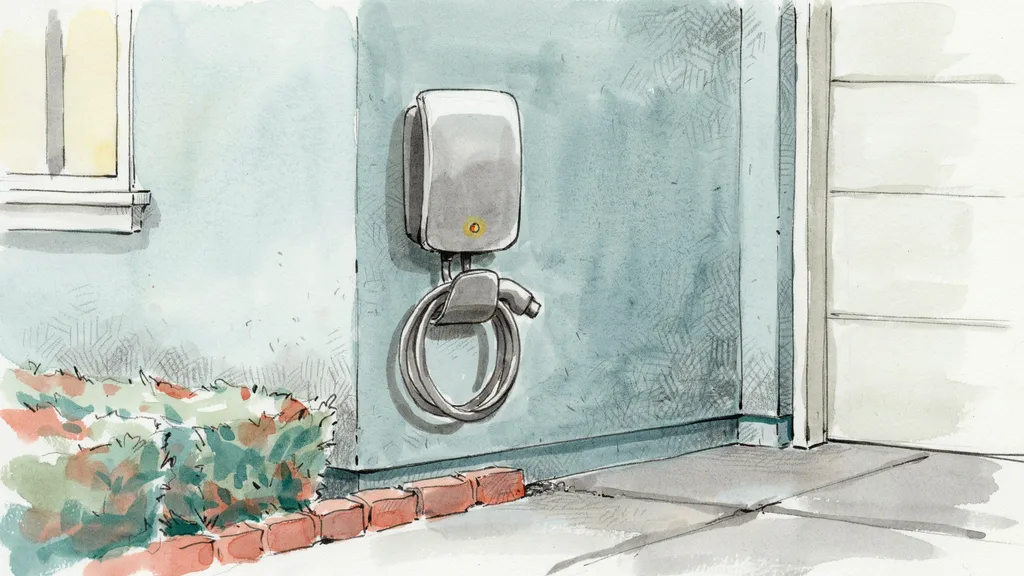
From 1 January 2025, an employer-installed home EV charger is BIK-exempt provided:
- The employee uses the company car for business journeys
- The company car is a BEV (the home-charger exemption does not apply to PHEVs)
- The employer retains ownership of the charger
- The charger is installed at the employee's primary residence
The exemption stacks with the OMV reduction on the company car itself. Workplace EV charging — provided to all staff at the employer's premises — has been BIK-exempt for both BEV and PHEV since 2018. See our workplace EV charging guide for the full mechanics including who pays for the electricity, who maintains the equipment and what happens if the employee leaves.
Worked examples — six 2026 scenarios

1. €50k BEV, 35,000 business km, income over €70k (2026)
Cat A1, taxable OMV €20,000 (€50k − €30k), 12% rate. Annual BIK €2,400. Tax cost at 52% = €1,248/yr or €104/month.
2. Same €50k BEV, same scenario, in 2028
Taxable OMV €47,500 (€50k − €2,500), 12% rate. Annual BIK €5,700. Tax cost at 52% = €2,964/yr or €247/month. The OMV reduction taper more than doubles the cash cost — and this applies to the same car in its third year, not just to cars delivered in 2028.
3. €40k petrol Cat C (130 g/km), 28,000 business km (2026)
Cat C, taxable OMV €30,000 (€40k − €10k), 24% rate (26k–39k band). Annual BIK €7,200. Tax cost at 52% = €3,744/yr or €312/month.
4. €60k diesel Cat D (160 g/km), 18,000 business km (2026)
Cat D, taxable OMV €50,000 (€60k − €10k), 33.75% rate (low band). Annual BIK €16,875. Tax cost at 52% = €8,775/yr or €731/month.
5. Sole trader vs employee — different rules
BIK applies to employees and directors. Sole traders use a different system — they claim actual business expense proportions on a personally-owned car (and cannot use civil service mileage rates). For a sole trader, BIK is irrelevant; the car is treated as a business asset with capital allowances and apportioned running costs. See our mileage rates guide for the sole-trader path.
6. Standard-rate taxpayer (~27%) on the same €50k BEV
Annual BIK €2,400 × 27% = €648/yr or €54/month. Lower-rate taxpayers on EV company cars in 2026 effectively get the company car at the price of a phone bill.
Track every business kilometre — Revenue-ready.
BIK rates depend on annual business mileage, and Revenue requires a contemporaneous log. odo.ie Progives you a Revenue-ready trip logbook with date, from/to, distance and purpose for every journey — auto-tagged business or private. €8/month for one car, family-share included. The free tier still gives you NCT / tax / insurance reminders.
Sources
- Revenue's Benefit-in-Kind: Employer Provided Vehicles — official rate tables and OMV reduction rules.
- Finance Act 2024 — established the OMV reduction taper schedule.
- Budget 2026 documentation on gov.ie — introduced Category A1 for EVs and confirmed the OMV reduction levels for 2026.
- Grant Thornton, BDO, Mahony Fleet, DriverFocus — technical analyses of the 2026 changes.
- citizensinformation.ie — BIK overview.
- Enhanced Reporting Requirements (ERR) — employer reporting since 2024.