Turn left on entering and go clockwise. Yield to traffic from your right or already on the roundabout, but keep moving if it’s clear. Exits from 6 to 12 o’clock: approach in the left lane; from 12 to 6 o’clock: the right lane — unless lane markings say otherwise. Going straight, don’t indicate until you pass the exit before yours. Never drive over a mini-roundabout’s painted circle.
What the law actually says
Much of what drivers think of as roundabout “law” is guidance. These are the parts that are legally binding:
- Turn left on entering. “When entering a roundabout, a driver shall turn to the left” (Road Traffic (Traffic and Parking) Regulations 1997, Art. 15).
- Yield at the entry. Roundabout entries have a yield line where approaching traffic yields to traffic already circulating; you must yield to traffic on the major road.
- Changing lanes. You must not move from one lane to another without yielding to traffic in that lane (Art. 8).
- Lane arrows. Where arrows are painted in a lane, you must follow them (Art. 27). Where there are none, lane choice is guidance.
- Mini-roundabouts. Yield to traffic on the mini-roundabout, turn left, and never drive wholly or partly along or across the painted circle (S.I. 332/2012, Reg. 5).
The golden rule: which lane
On a roundabout with two lanes, the Rules of the Road uses a clock face. You arrive at 6 o’clock. Exits between 6 and 12 o’clock — turning left or going straight on — should generally be approached in the left-hand lane. Exits between 12 and 6 o’clock — turning right or going round — in the right-hand lane.
Lane and signal for every exit
Pick an exit and a roundabout size. The green line is your path; the yellow markers show exactly when to indicate.
Turning right — a later exit
- Approach. Get into the right-hand lane and indicate right as you approach.
- Yield. Give way to traffic from your right or already on the roundabout.
- On the roundabout. Keep to the right-hand lane, still indicating right.
- Exit. After passing the exit before yours, change to the left indicator, check your mirrors, move over to the left and exit.
Where lane arrows or spiral markings are painted on the roundabout, follow those instead.
Mini, multi-lane and other roundabouts
Mini-roundabouts
A painted white circle instead of an island, usually where approach speeds are 50 km/h or less. Yield to traffic on it, turn left and drive around the circle — never over it, whatever you’re driving.
Multi-lane and spiral roundabouts
Follow any lane arrows on the approach. On spiral roundabouts the lane lines curve outwards so each lane leads you off at a set exit — choose your lane before you enter and follow it round. Watch for vehicles leaving at the next exit and drivers straddling lanes.
Roundabouts with traffic lights
Some roundabouts are controlled by traffic lights. Where they are, obey the lights — breaking a red light is a €80 fixed charge with 3 penalty points. Lane guidance lines may be painted to lead you through.
Cycle-friendly roundabouts
In 2023 Fingal County Council opened what it described as Ireland’s first cycle-friendly roundabout, on the Church Fields Link Road in Mulhuddart, Dublin 15. It separates cyclists, pedestrians and vehicles, giving people walking and cycling their own space around the junction.
Two-lane roundabouts: when someone cuts across
Same approach, two lanes, two drivers. These are the situations that start the arguments: someone uses the inner lane because it is moving, then comes back across you at the exit, or carries on past the exit their lane was marked for. Ireland drives on the left, and traffic on the roundabout goes clockwise.
On the roundabout itself, the left-hand lane is the outer one, nearer the exits. The right-hand lane is the inner one, nearer the island.
Three points in the RSA Rules of the Road settle most of these. Follow the arrows and other markings — they override the general clock-face rule. If you move from one lane into another, you give way to traffic already in the lane you are moving into. And signalling does not give you the right of way. An indicator, or any signal light, only shows what you mean to do. It does not let you change lanes, cut in, or take a gap. The driver who moves still has to give way to whoever is already in the lane they want.
Signs and markings on the day override the pictures below. This is the usual case, not a finding about any particular crash, and it is not legal advice.
1. Going straight, and the other driver cuts in at the exit
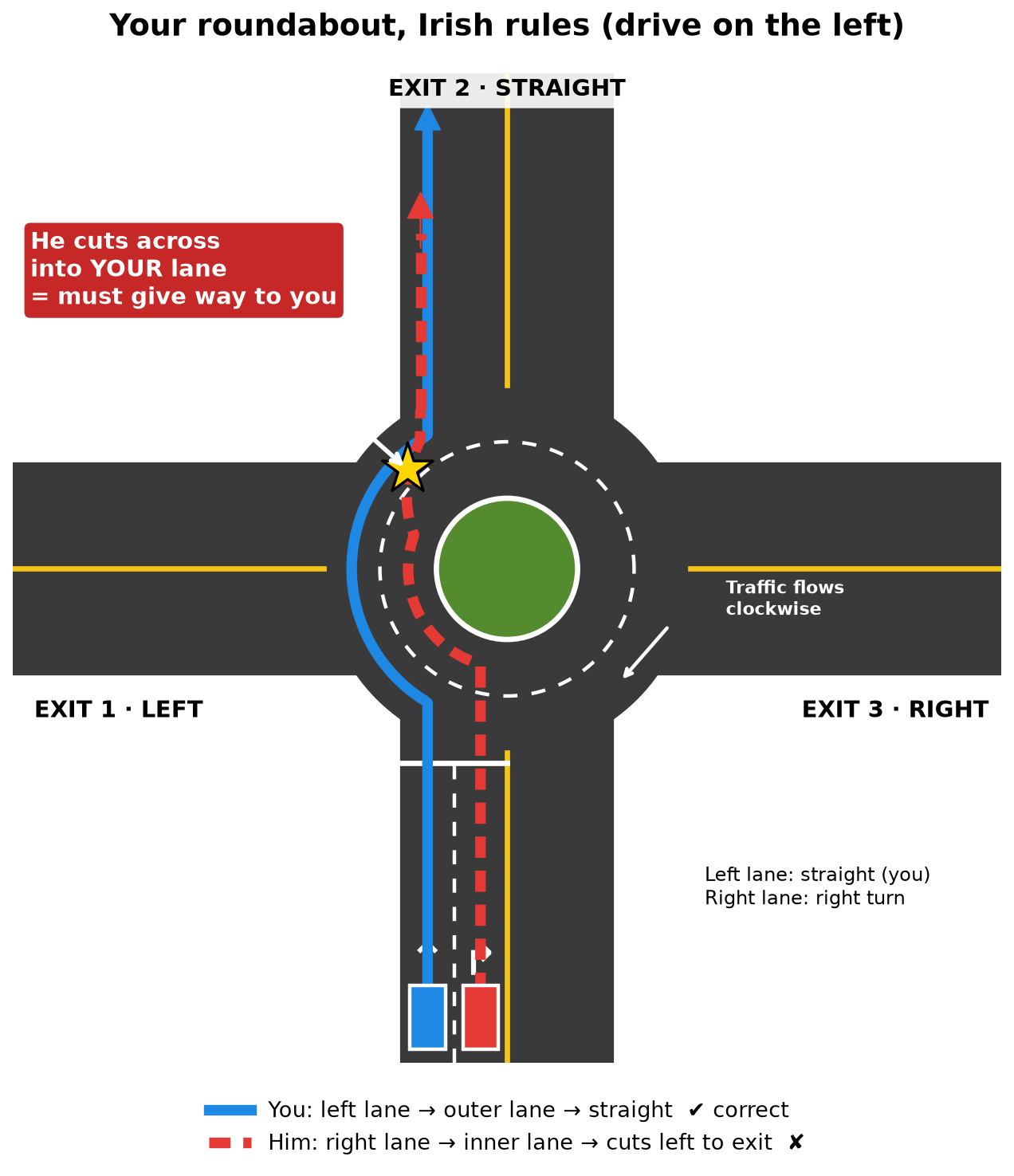
The arrows on this approach say left lane for straight on, right lane for the right turn. Nothing on the road sends the right lane straight ahead.
Car A is in the left-hand lane, joins the outer lane, and leaves at the straight exit. That is the normal line for going straight.
Car B takes the right-hand lane and the inner lane, often because that side is shorter, then moves left across the outer lane just in front of A to take the same exit.
In most cases B is wrong. Coming out of the inner lane is a lane change, and the driver who moves has to give way to the car already in the outer lane. A was already there, on the line for that exit. A quieter inner lane does not rewrite the arrows, and it does not let B out in front. An indicator does not change that. It shows B means to come across. It does not give B the lane, or a gap in front of A. B still has to give way.
Do
- Use the left-hand lane for straight on when the arrows say so — or, where there are no arrows, when the exit is around 12 o’clock.
- Stay in the outer lane and leave from it.
- If you are in the inner lane and you need to come out, wait until the outer lane is clear.
Don’t
- Take the right-hand lane for a straight exit because the queue looks shorter.
- Move left across a car that is already in the outer lane.
- Treat an indicator as permission to cut in.
2. Half-right exit: the shortcut through the outer lane
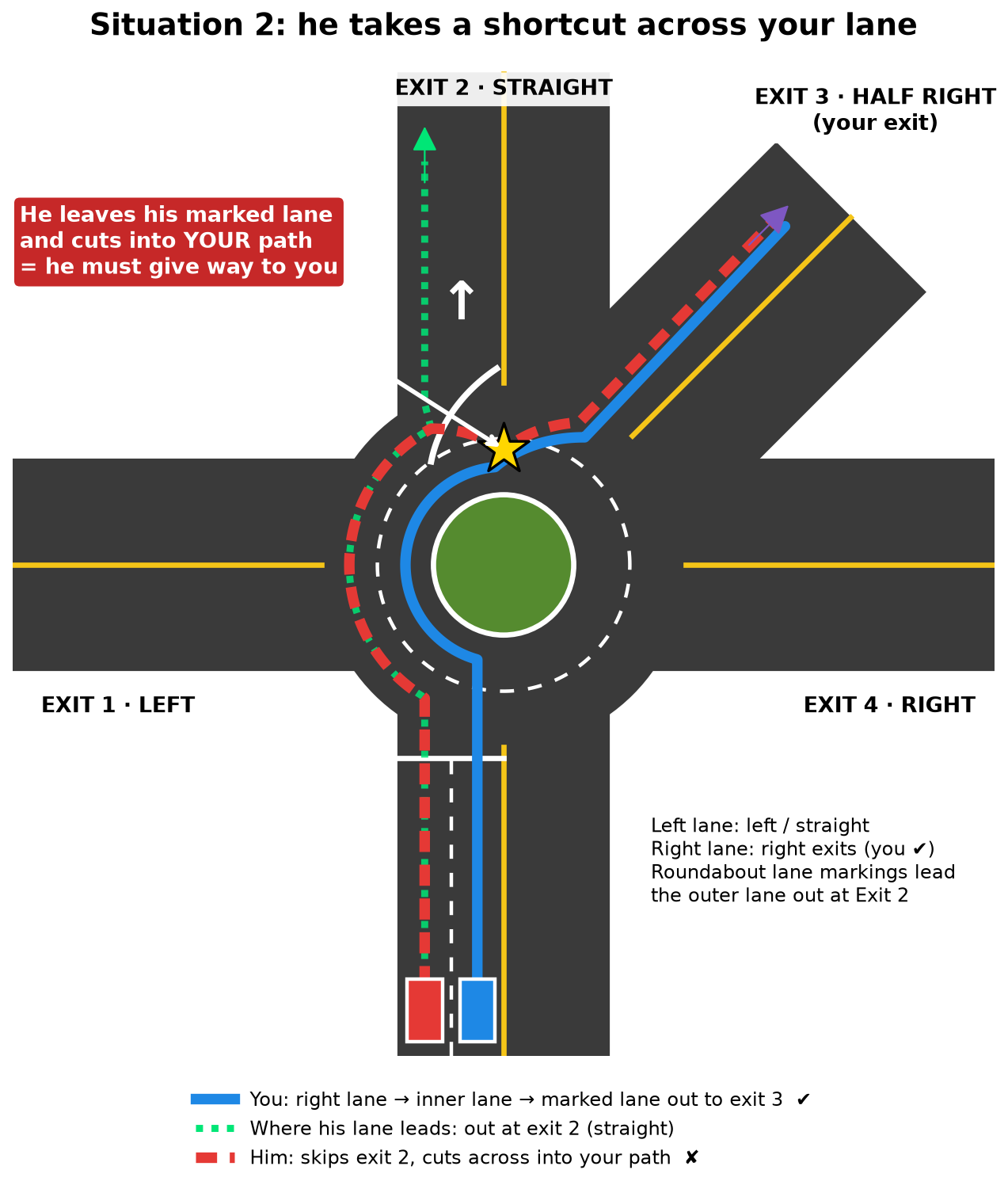
The arrows here are tighter. The left lane is for left or straight only. The right lane is for the half-right exit — the one between straight on and a full right — and for anything further round. The lane marking on the roundabout leads the outer lane off at the straight exit.
Car A is in the right-hand lane, follows the inner lane, and leaves at the half-right exit on the lane marked for it.
Car B starts in the left lane, skips the straight exit that lane was marked for, and stays on the outer lane to reach the half-right exit. That means crossing the marking, and crossing A.
B has left the lane the arrows gave them and cut across the driver who was in the right place for that exit. In most cases that is on B. Once arrows are painted, the clock-face rule does not put B back in the right lane. The markings win. Indicating does not make the shortcut allowed. If B signals and then moves across A, that only shows what B means to do. B is changing lanes, and still has to give way to A.
Do
- Read the arrows before you enter. They override the general rule.
- If the outer lane is led off at the straight exit and you came from the left lane, leave with it.
- If you are in the lane marked for the half-right exit, hold that line.
Don’t
- Skip the straight exit in a lane that was only marked for left or straight.
- Cut across the car who took the lane marked for the half-right exit.
- Push in once you are on the roundabout to fix a lane you missed on the approach.
- Use an indicator as a right to skip your exit, change lanes, or take the gap.
3. The one thing that changes it: they are already beside you
There is one case where the driver in the wrong lane is not the one who generally carries the contact. It is about the moment Car A moves out of the inner lane, in the same half-right exit as above.
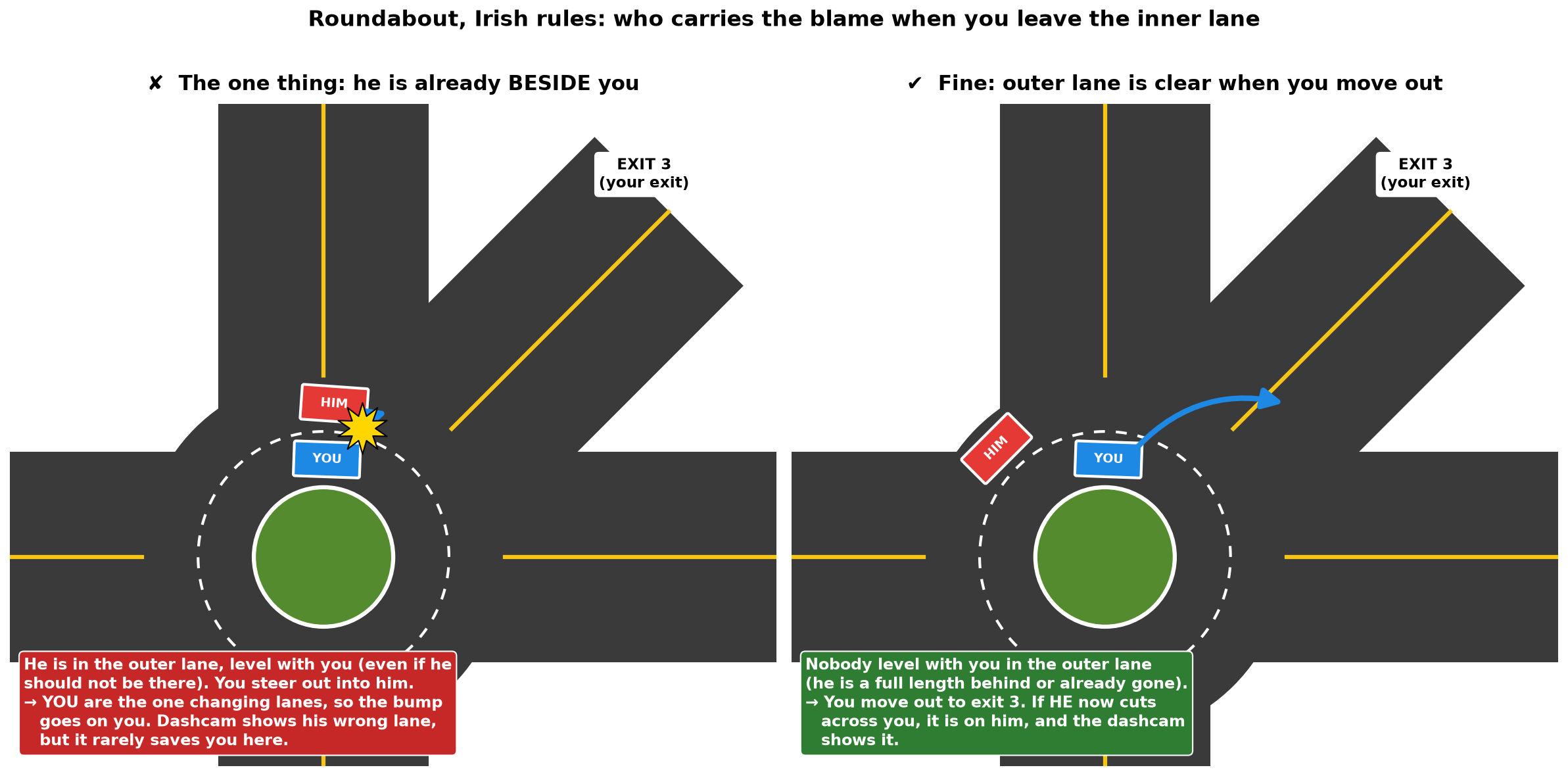
If B is already level with A in the outer lane, A is the one changing lanes. It does not matter that B should not have been there. Steering out into a car that is already beside you is the move, and in most cases the bump is put on the driver who moved out. A dashcam that shows B in the wrong lane is worth having. It rarely undoes driving into the side of someone who was already there.
If the outer lane is clear — B a full car length behind, or already gone — A can move out to the exit. That is the normal way to leave. If B then comes across into that path, B is the one changing lanes and has to give way. That is the picture you want: the gap was there, and B closed it.
Do
- Check the outer lane before you leave the inner one. Mirror, then a look to the side.
- Move out only when nobody is level with you.
- If a car is already beside you, hold your lane and let them go, even if they should not be there. Take the next gap.
Don’t
- Steer out for “your” exit while a car is alongside, however wrong their lane was.
- Sit half a length behind them and move at the same moment.
- Rely on the arrows to explain a bump into the side of a car that was already there.
4. The single-lane exit squeeze
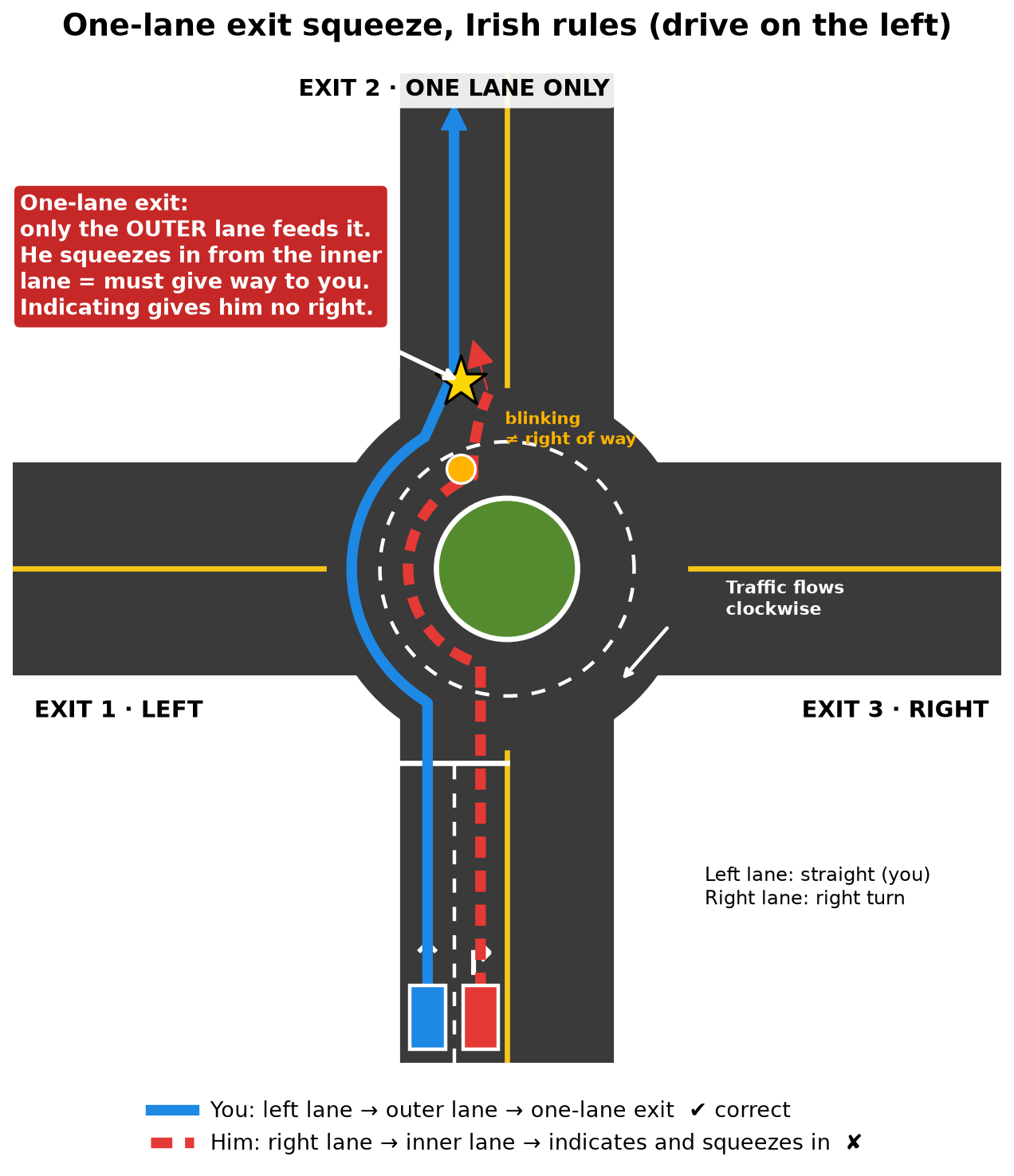
Some exits are marked from the left lane only, and the road off the roundabout narrows to one lane. Car A is in that left lane and takes it. There is often a queue behind.
Drivers in the right lane are not marked for that exit. They still squeeze into it to skip the queue, and they often indicate as they come across.
The indicator only shows the intention. It gives no right of way, and no right to change lanes, cut in, or take the gap. They are moving into A’s lane, so they have to give way to A. You do not have to brake to make a gap. Letting them in is courtesy, not a duty. Ease off if a hit is otherwise coming — avoiding the contact comes first — but the lane the arrows gave you is yours to use.
Do
- Take the exit from the lane marked for it, at a steady pace.
- Read an indicator as a warning that someone may try to squeeze in, not as a claim on your lane.
- Let them in if you want to. That is a courtesy you are choosing to give.
Don’t
- Squeeze into an exit your lane is not marked for, indicator or not.
- Expect the car in the marked lane to brake and make you a gap.
- Speed up only to shut someone out. You still do not have to give the lane up.
If you are the car in the correct lane and someone is likely to cut in, where you sit is what keeps the argument simple. This is practical driving, not an extra rule.
- Sit level with the outer-lane car, or slightly ahead. Half a length behind is the awkward spot: you are not clearly in front, and you are not clearly behind, so a cut-in looks shared.
- If you cannot get level, drop back a full car length early, before the exit. Any cut-in then happens in front of you, and you are not the one steering into them.
- A dashcam aimed so it shows the arrows on the approach is the best record of which lane was for which exit. The dispute is usually those arrows, and who moved.
- An indicator on the other car only shows intent. As the Rules of the Road says, signalling does not give the right of way. It does not hand them your lane or a gap. If they move across, they still have to give way to you.
Myths vs the rules
Fines and penalty points
| Offence | Fixed charge pts | Fine (28 days) | Next 28 days | Court pts |
|---|---|---|---|---|
| Failing to turn left when entering a roundabout | 1 | €60 | €90 | 3 |
| Breaking the rules for a mini-roundabout | 1 | €60 | €90 | 3 |
| Failure to yield | 2 | €80 | €120 | 4 |
| Failing to yield at a yield sign or yield line | 3 | €80 | €120 | 5 |
| Breaking a red light | 3 | €80 | €120 | 5 |
| Junction rules (e.g. wrong lane when turning) | 1 | €60 | €90 | 3 |
| Ignoring road markings | 1 | €60 | €90 | 3 |
Which offence applies depends on what happened and how the Garda charge it. For every penalty point offence, see our penalty points guide.
Roundabouts on the driving test
The RSA’s own driving-test booklet lists three of the common reasons for failing as involving roundabouts: inadequate observation at roundabouts, incorrect road position at roundabouts, and inadequate progress at roundabouts. The Rules of the Road also asks learners to avoid undue hesitancy at roundabouts.
- Observation: check right early, then again before you go; mirrors and blind spot before moving left to exit.
- Position: the right lane for your exit, and stay in it — don’t drift across lanes on the roundabout.
- Progress: take a safe gap when it comes; don’t stop if the way is clear.
More on the test in our guide to the common reasons for failing.
In the RSA’s most recent junction breakdown (2018), there were 291 collisions at roundabouts in built-up areas — 16.9% of collisions at junctions there — and 35 outside built-up areas (6.0%).
Learning to drive? Keep your lessons, test date and car costs in one place
odo.ie tracks fuel, servicing, NCT, motor tax and insurance, with reminders before anything is due — and logs any one-off costs. Solo free for 1 vehicle; Family €4/month for 3 vehicles; Pro €8/month for 10 with a Revenue-ready trip logbook. 170+ Irish guides, no ads, EU data residency.
Frequently asked questions
Sources
- Road Traffic (Traffic and Parking) Regulations 1997 — revised (Art. 15 roundabouts, Art. 8 lanes, Art. 21 yield, Art. 27 lane arrows)
- S.I. No. 332/2012, Regulation 5 — rules for use of a mini-roundabout
- RSA — Rules of the Road (roundabouts, pp. 135–138; cyclists p. 215)
- Traffic Signs Manual, Chapter 7 (road markings: roundabout yield lines, spiral markings), October 2025
- Traffic Signs Manual, Chapter 5 (regulatory signs: turn left, mini-roundabout), October 2025
- RSA — penalty point offences and fines
- RSA — Preparing for your driving test (June 2024), common reasons for failing
- RSA — Road Casualties and Collisions in Ireland 2018 (collisions at roundabouts, Table 15)
- Fingal County Council — Church Fields Link Road and Ireland’s first cycle-friendly roundabout