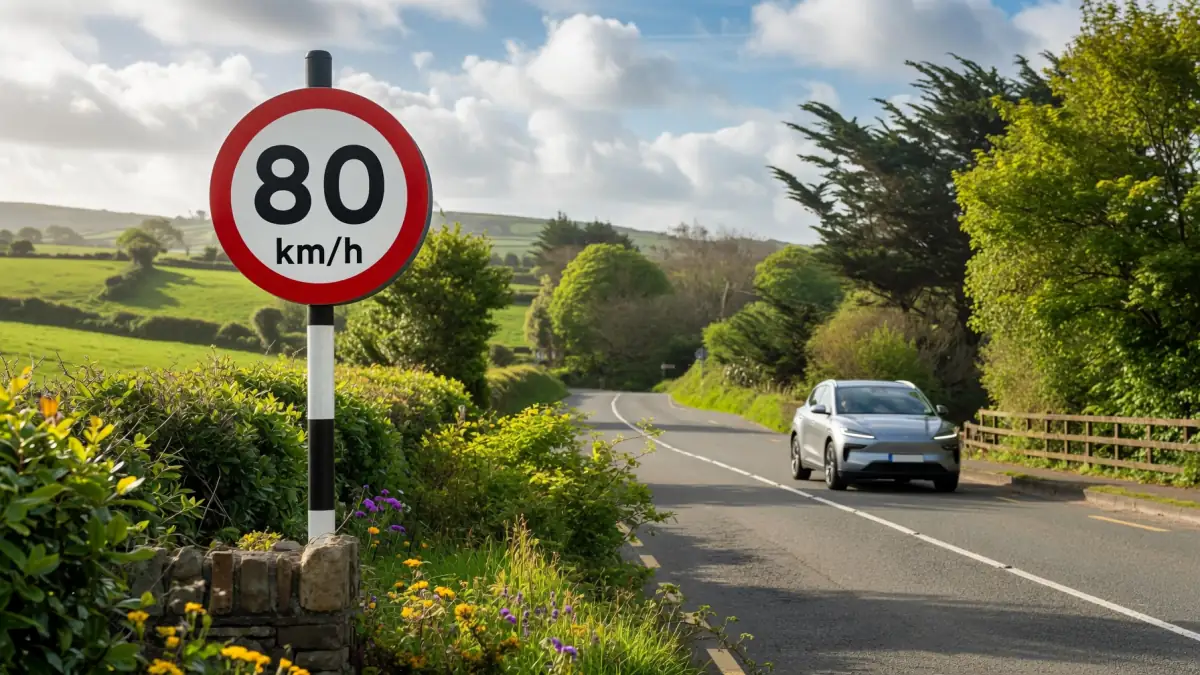
Current Irish default limits: motorway 120, dual carriageway 100, national roads 100 (secondary reducing to 80), regional 80, rural local 60(reduced from 80 on 7 Feb 2025), urban 50 (with 30 km/h special bye-laws being adopted in urban cores by 31 March 2027). Speeding FCN is €160 + 3 points, rising to €240 after 28 days and court after 56 days. Enforcement: 58 GoSafe vans across 1,901 zones, 9 static cameras and 5 average-speed systems (Port Tunnel, M7, N3, N5, N2) — all on our speed camera map. The changes are driven by the 2020–2024 stat that 73% of road deathsoccurred on 80 km/h+ roads.
Current default speed limits by road type (2026)
| Road type | Sign prefix | Default limit | Notes |
|---|---|---|---|
| Motorway | M | 120 km/h | Variable limits on M50 / parts of M1 via VMS |
| Dual carriageway | — | 100 km/h | Unless posted differently |
| National primary | N (blue) | 100 km/h | No reduction announced |
| National secondary | N (green) | 100 km/h | Planned reduction to 80 km/h (not yet in force) |
| Regional road | R | 80 km/h | Unchanged |
| Rural local road | L | 60 km/h | Reduced from 80 on 7 Feb 2025 |
| Built-up / urban | (none) | 50 km/h | 30 km/h bye-laws being adopted in urban cores |
These are default limits — the limit that applies when no specific sign is posted. Posted limits always override the default. Temporary limits at roadworks and variable message signs on motorways also always override.
The February 2025 change — rural local roads to 60 km/h
On 7 February 2025, the default speed limit on Ireland's rural local roads — the L-numbered roads outside built-up areas — dropped from 80 km/h to 60 km/h. This is the biggest speed-limit change in Ireland in years, affecting roughly 82,000 km of road — more than any other tier of the Irish road network.
What changed on the signs
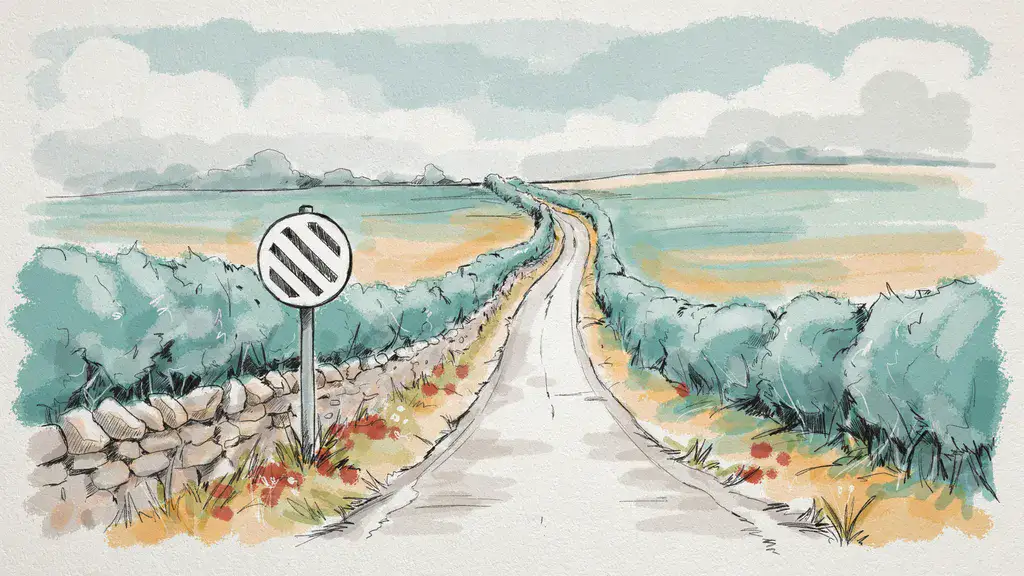
The "Rural Speed Limit" sign — a white circular disc with five diagonal black lines, often shown with a separate plate reading "Go Mall / Slow" — previously meant 80 km/h. From 7 February 2025 onwards, it means 60 km/h. The sign itself was not changed; its meaning under the Road Traffic Act 2024 was.
This is why local knowledge matters less than it used to. If you haven't driven an Irish L-road since early 2025, the familiar white-disc-with-diagonals sign now means 60, not 80. There's no grace period — enforcement has applied from day one.
Which roads are affected
- The rural L-series roads — typically narrow, often winding, with limited shoulder
- Includes boreens, townland roads, and many rural routes that were previously signposted only with the white-disc Rural Speed Limit sign
- Does not apply to regional (R) or national (N) roads — those retain their posted limits
- Within built-up/urban areas, normal urban limits apply (typically 50 km/h)
Coming changes — 2026 and 2027
National secondary roads: 100 → 80 km/h
The Road Traffic Act 2024 provides for reducing the default from 100 km/h to 80 km/h on Ireland's national secondary roads— the green-signposted 'N' roads, such as the N3 beyond Cavan, N5, N15, N21, N22, N71, N72 etc. The reduction has not commenced as of early 2026 but is expected to be introduced later in the year. Local authorities have begun preparing signage and road-network audits.
Urban 30 km/h — by 31 March 2027
The most substantial coming change. From late 2025, Irish local authorities were directed to start adopting special speed limit bye-laws to lower urban limits from the default 50 km/h to 30 km/h in urban cores, housing estates, residential streets and roads adjacent to schools.
- Mechanism: local authority bye-laws, not a national default change. Each council holds statutory public consultation and a vote.
- Timeline: target to have operational by 31 March 2027
- Funding: €20 million central funding for local authorities to cover signage, poles and implementation
- Scope: identified "Urban Speed Limit Zones" (USLZ) cover the urban core, with some councils extending to school approaches and housing estates
Because councils decide independently, the 30 km/h limit won't arrive at the same pace everywhere. Dublin City Council and some others have moved quickly; rural counties with smaller urban cores are generally taking longer. Always look at posted signs — the default is still 50 unless a bye-law changes it locally.
How to read the Irish speed-limit sign system
Irish limits use the standard European circular speed-limit disc. Three variants matter:
| Sign | What it means |
|---|---|
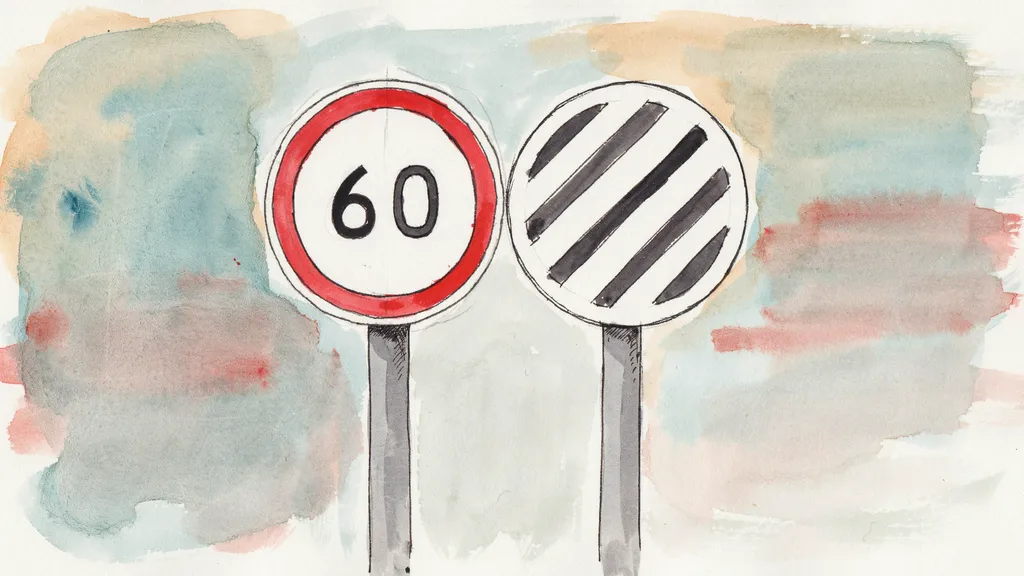
| White disc with red border + black numbers (e.g. "50") | Specific posted limit in km/h — overrides the default for that section |
| White disc with five diagonal black lines (Rural Speed Limit sign) | Default rural limit — now 60 km/h on local roads (since 7 Feb 2025) |
| Matrix / variable message signs on motorway | Posted variable limit — always follow the displayed number, overrides the 120 |
| Flashing amber "School Zone 30" sign | School-zone limit during opening/closing times — 30 km/h |
| Temporary roadworks sign (yellow background) | Temporary limit — legally binding even when lower than default |
A limit sign applies from the point you pass it until you pass a different limit sign or enter a different road type. Always look for the next sign — rural Irish roads often transition through several posted limits within a few km.
The urban 30 km/h roll-out — what to expect
The 30 km/h limit is not a blanket rule. Local authorities identify "Urban Speed Limit Zones" (USLZ) based on published Department of Transport guidelines (Sept 2025) — covering:
- Urban cores — commercial / town-centre streets with high pedestrian and cyclist footfall
- Housing estates — residential streets with frequent children playing, crossing, pedestrian activity
- Roads adjacent to schools — already many have school-zone 30 km/h limits, being extended further
- Town and village centres — including many small rural villages with through-traffic
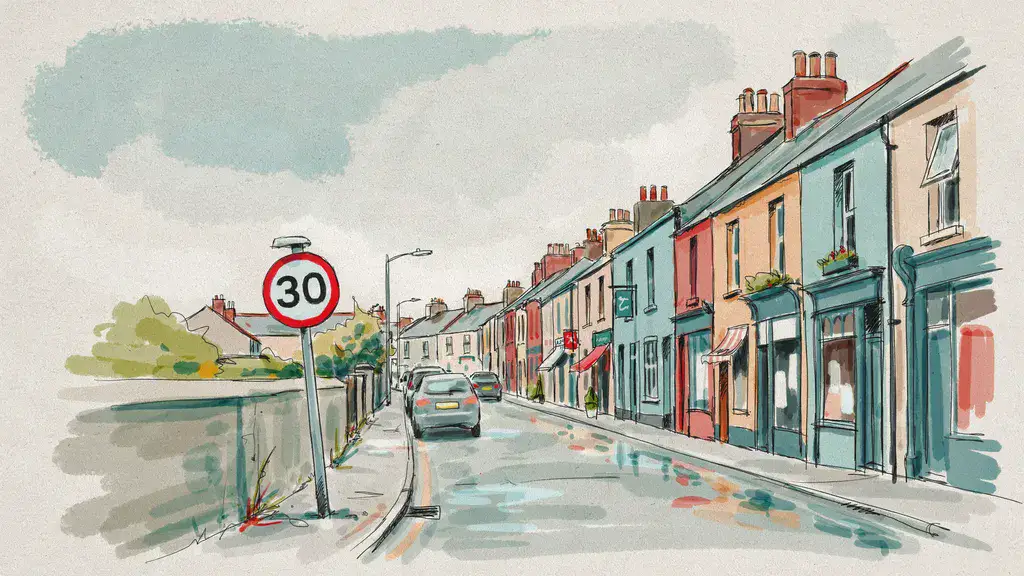
Expect the 30 km/h signs to appear gradually through 2026 and into 2027. Councils are at different stages — some consultations are already complete and bye-laws adopted, others are just starting. When you see a new posted 30 sign, it's enforceable from the day the bye-law takes effect (usually stated in local press and council communications).
Typical target areas include Dublin City, Cork City, Galway City, Limerick City and Waterford City cores, plus growing town centres like Naas, Mullingar, Dundalk and Drogheda. Check your local council's website for the exact bye-law status in your area.
Speed cameras in Ireland — types, locations, 2026 changes
1. GoSafe mobile vans — the primary enforcement
An outsourced mobile safety camera network operated under Garda contract. 58 vans work across 1,901 designated enforcement zones (a 390-zone increase from 1,511 on 1 January 2026). Zones are chosen mainly on collision history — the Garda weight fatal, serious and minor collisions on each stretch — plus community requests made through local Garda superintendents.
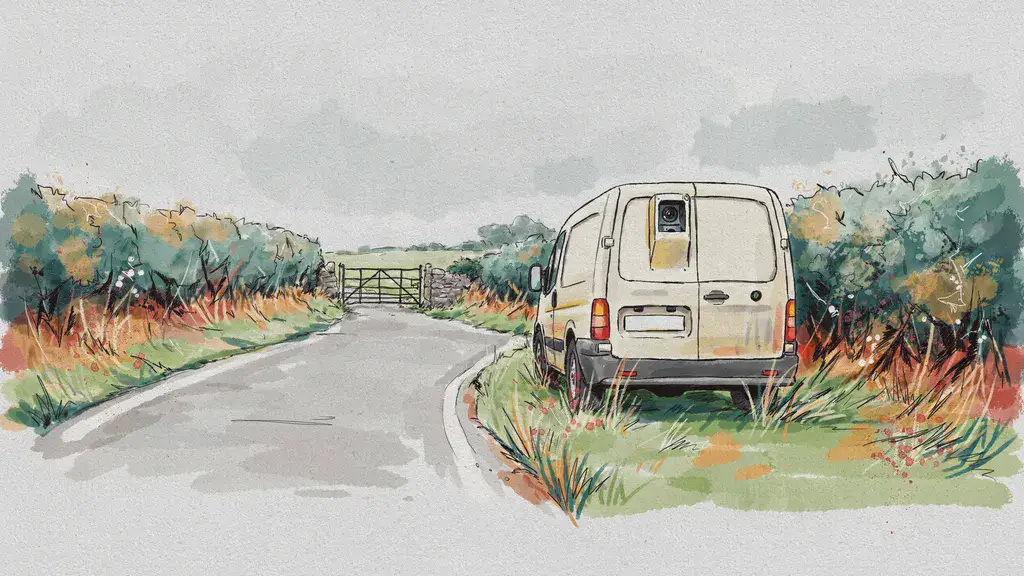
The Garda publish the full list of zones (not the daily position of each van), so a zone being on the list doesn't mean a van is there every day. We've put every zone on an interactive map, searchable by road, town and county, in our speed camera locations guide.
2. Static speed cameras — permanent fixed installations
Nine static cameras are operational. Their locations were announced by Gardaí in May 2024 and they went live between December 2024 and August 2025:
- N17 — Ballinsmaula, north-east of Claremorris, Co. Mayo
- N59 — Aubwee, between Moycullen and Galway city
- N13 — Killyverry, east of Letterkenny, Co. Donegal
- N69 — Ballyhomin, east of Askeaton, Co. Limerick
- R772 — Aske, Gorey, Co. Wexford
- N22 — Farnanes, between Lissarda and Ovens, Co. Cork
- N80 — Graiguenaspiddoge, Co. Carlow
- N25 — Ballynamona, Glenmore, Co. Kilkenny
- Crumlin Road — Dolphin’s Barn, Dublin 12
€9 million was allocated in Budget 2025 for up to 100 new speed cameras, but as of October 2026 the Garda still list nine static cameras. Ireland’s first National Safety Camera Strategy (April 2026) hands fixed and average-speed cameras to Transport Infrastructure Ireland, without a number or date for new ones.
3. Average-speed cameras — the enforcement game-changer
Rather than measuring instantaneous speed, average-speed cameras compute your average speed between two camera gantries. You can't slow for the camera and speed up afterwards — the system calculates your average over the whole zone.
Five zones currently operate:
- Dublin Port Tunnel — full length, since 2017
- M7 — Junction 26 Nenagh (West) to Junction 27 Birdhill, Co. Tipperary, since April 2022
- N3 — Kilduff to Billis, Co. Cavan, since October 2024
- N5 — Lislackagh to Cuilmore near Swinford, Co. Mayo, since October 2024
- N2 — Cullen to Ballymagarvey near Slane, Co. Meath, since March 2025
See exactly where each one starts and ends on our speed camera map.
Before the M7 system went in, fewer than 70% of drivers kept to the 120 km/h limit on that stretch. During the pilot, compliance rose to just under 90%, according to the Garda. Six people had died there in the eight years before the cameras.
Speeding penalties and fines in 2026
| Stage | Fine | Penalty points | Timeline |
|---|---|---|---|
| Fixed Charge Notice — paid within 28 days | €160 | 3 | Standard |
| Unpaid after 28 days | €240 (1.5× increase) | 3 | Escalation notice |
| Unpaid after 56 days — court summons | Up to €1,000 + costs | Up to 5 on conviction | District Court |
| "Avoid court" payment (7+ days before hearing) | €320 (2× original) | 3 | Pre-court settlement |
Penalty points stay on your licence for 3 years from the date of the offence. Reaching 12 points in 3 yearstriggers an automatic 6-month disqualification. See our penalty points guide for the full list of point-bearing offences.
Unlike some FCN offences that are capped, speeding points accumulate on top of other motoring offences. Two speeding tickets within 3 years = 6 points. A third within 3 years = 9 points. That leaves very little margin for any other penalty-point offence — drivers accumulate 12 points and lose their licences faster than they expect.
Insurance impact
Insurers routinely load premiums for drivers with speeding convictions — typically 10–30% on renewal for a first-offence driver, significantly higher for multiple or serious offences. See our car insurance guide for more on how penalty points affect your premium.
Special zones and variable limits
School zones
Flashing amber "School Zone" signs drop the limit to 30 km/h during opening and closing times (typically 8–9:30am and 2:30–4pm on school days). Outside those hours, the default road limit applies. Many schools have permanent 30 km/h signs being added under the urban roll-out.
Hospital zones
Some hospital approaches and ambulance routes have posted 30 or 40 km/h limits for pedestrian safety. Follow the posted sign.
Roadworks
Temporary limits at roadworks — typically 60 or 80 km/h on motorway, 40 or 50 km/h on national and regional — are legally binding even when lower than the permanent default. Enforcement is routine at major motorway works via GoSafe vans positioned at the downstream end.
M50 variable limits
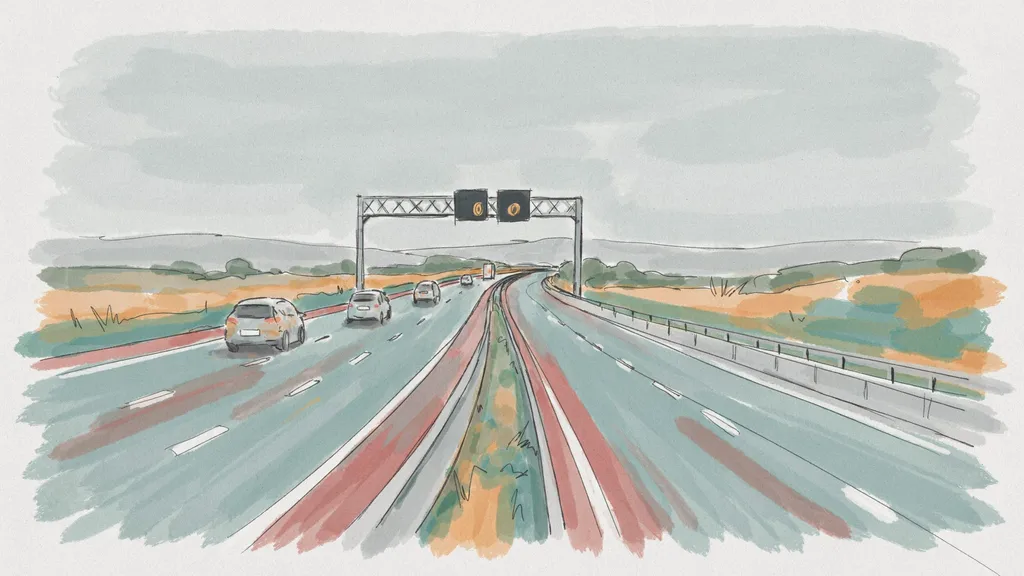
The M50 has variable message signs at overhead gantries. During incidents, heavy congestion, or adverse weather, the limit can drop to 80, 60 or even 40 km/h. The displayed limit is always the legal limit — ignoring a VMS sign is treated identically to ignoring a fixed sign.
Learner and novice driver maximum
Learner (L-plate) and novice (N-plate) drivers have maximum speed conditions but these largely align with posted limits. Importantly, L-plate drivers may not use motorways. N-plate drivers can use motorways but operate under novice alcohol and penalty-point limits — see our N-plates guide.
Why the limits are being lowered — the safety case
The speed-limit changes are not arbitrary. They're driven by a specific data point repeatedly cited by the RSA and Department of Transport:
Between 2020 and 2024, 73% of Irish road deaths occurred on roads with speed limits of 80 km/h or higher, and 47% of all serious injuries occurred on the same roads. Lowering the default on rural local roads from 80 to 60 targets the single most dangerous category of road in Ireland.
The "Slower Speeds, Safer Roads" strategy sits within Ireland's broader Road Safety Strategy 2021–2030, which commits to:
- 50% reduction in deaths and serious injuries on Irish roads by 2030
- Vision Zero (no road deaths or life-changing injuries) by 2050 — in line with EU road safety policy
- Alignment of Irish rural road limits with comparable European practice (many EU countries already have 60–70 km/h defaults on equivalent roads)
The physics is straightforward: the probability of a pedestrian surviving a collision drops sharply above 50 km/h, and above 60 km/h risks compound for all road users. Reducing the most dangerous category of road from 80 to 60 produces meaningful reductions in fatality and injury outcomes.
Track speeding fines, penalty points and motoring costs in one place
odo.ie tracks your fuel, servicing, NCT, motor tax and insurance — and lets you log any one-off motoring costs, including speeding fines, so the full cost of driving is in one place. Solo free forever for one vehicle, Family €4/mo for 3. Irish-built. Stay aware, drive safe.